Drone or Tractor for Spraying – Which Is the Better Solution
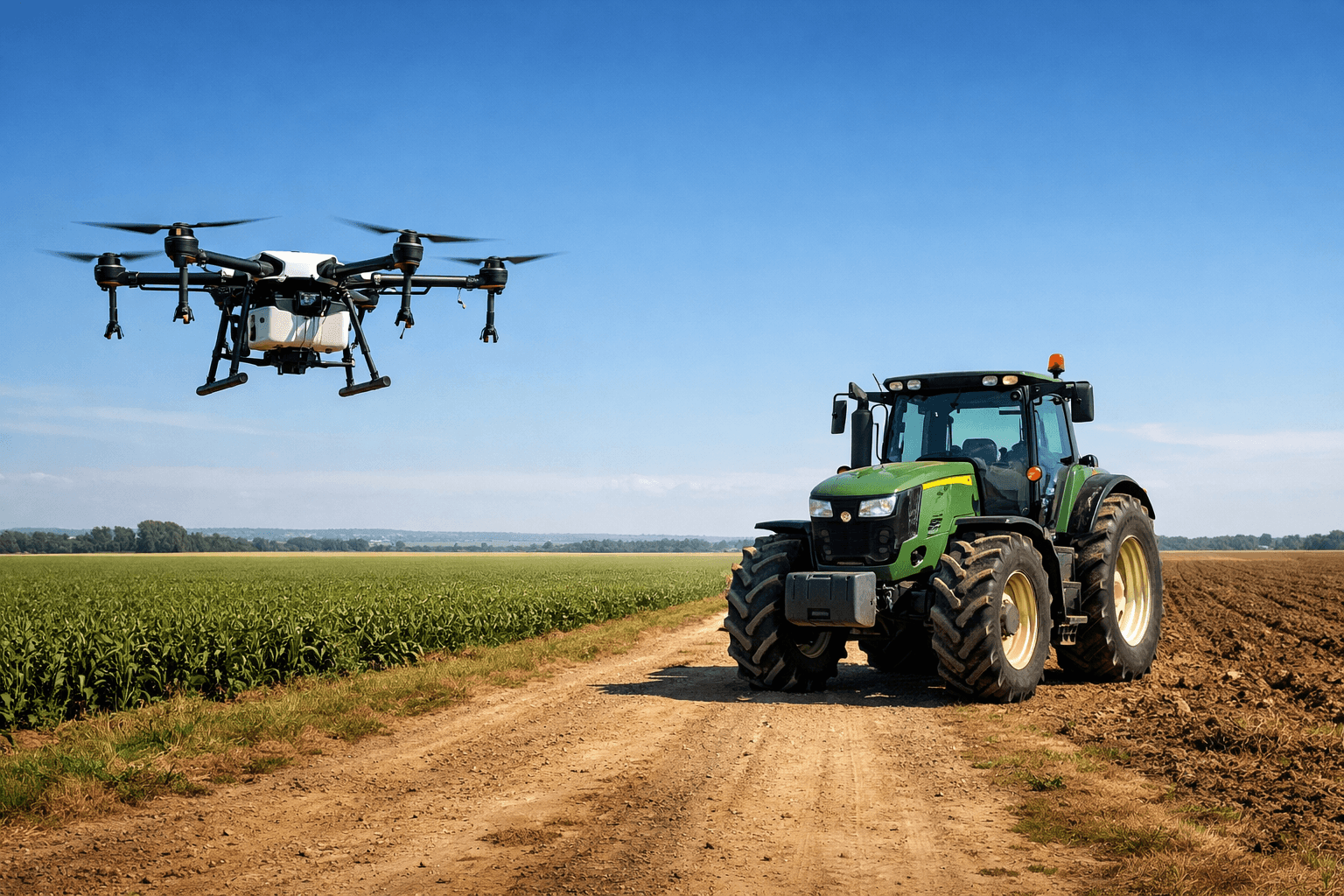
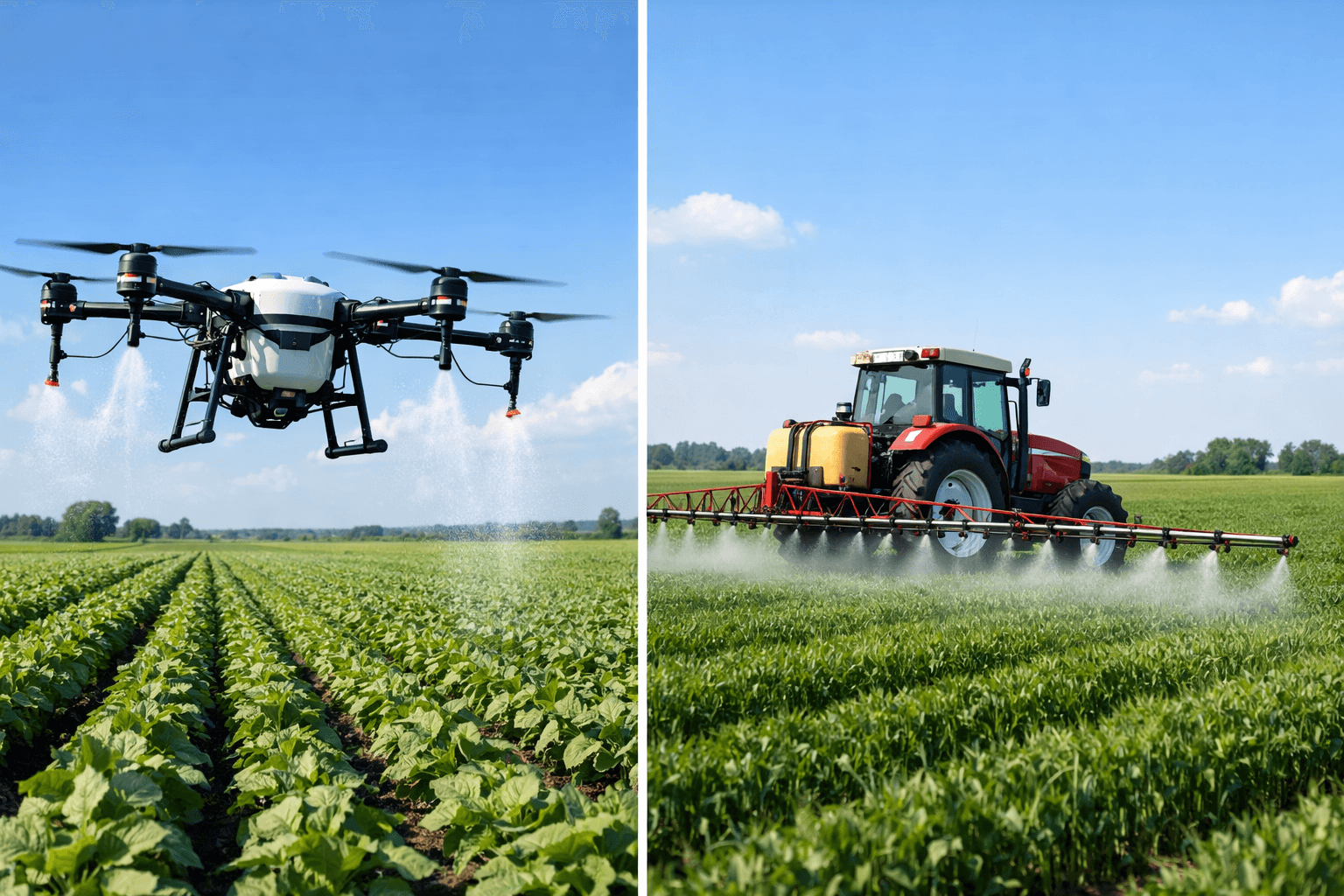
The question "drone or tractor for spraying" is occupying an increasing number of agricultural producers in Bulgaria. Tractor sprayers are a tried and familiar method, but drones are advancing rapidly and offering solutions that would have seemed impossible just a few years ago. Which method is better? The answer is not straightforward – it depends on the specific situation, crop, terrain and budget.
In this article we make an objective comparison across all key criteria: speed, price per decare, crop damage, precision, flexibility under various conditions and much more. Our aim is to help you make an informed decision.
Processing Speed – Which Is Faster
Tractor Sprayer
Modern tractor sprayers with wide booms (18–36 m) can treat 200–400 decares per day under optimal conditions. Speed depends on boom width, travel speed and refilling time. With larger tanks (2,000–3,000 L), fewer stops for filling are needed.
Agricultural Drone
A modern drone such as the DJI Agras T50 achieves up to 210 decares per hour under optimal conditions. In practice, daily productivity ranges between 1,500 and 3,000 decares – or 5 to 10 times more than a tractor. Automatic route planning and rapid refilling (40-litre tank, filling in 1–2 minutes) make the process exceptionally efficient. For more information on actual productivity, read our article on how many decares a drone sprays per day.
Conclusion: In terms of speed, the drone wins convincingly. This is especially important for emergency treatments – when you have a narrow spraying window due to weather or crop development stage.
Price per Decare – Which is Cheaper
Costs with a Tractor
The price of tractor spraying includes: fuel, equipment depreciation, operator's salary, water and preparations. The average price varies between 3 and 6 BGN/dka depending on the area and conditions. With own machinery it may be lower, but you must add maintenance, storage and insurance costs.
Costs with a Drone
The service of drone spraying typically costs between 4 and 8 BGN/dka depending on volume, crop and preparation. At first glance this appears more expensive, but important factors must be considered:
- Water saving: The drone uses 5–10 times less water (1–2 L/dka instead of 15–30 L/dka with a tractor). This means lower water transport costs and fewer logistical problems.
- Preparation saving: Precision drone spraying saves up to 30% on preparations thanks to centrifugal nozzles and uniform coverage.
- No hidden costs: No depreciation, maintenance, fuel, insurance.
Conclusion: When all factors are counted – including saved preparations and water – the drone often works out comparable or cheaper than the tractor. A detailed analysis of current prices can be found on our pricing page.
Crop Damage – Trampling and Compaction
This is one of the most important differences between the two methods and is often underestimated by farmers.
Tractor: 3–5% Loss from Trampling
When a tractor with a sprayer passes through the field, 3 to 5% of the area is track – directly trampled or damaged plants. For cereal crops this means:
- Broken stalks and damaged ears
- Soil compaction in the tracks
- Reduced aeration and impeded root system development
- For 1,000 dka the loss can be 30–50 dka of damaged area
Drone: Zero Trampling
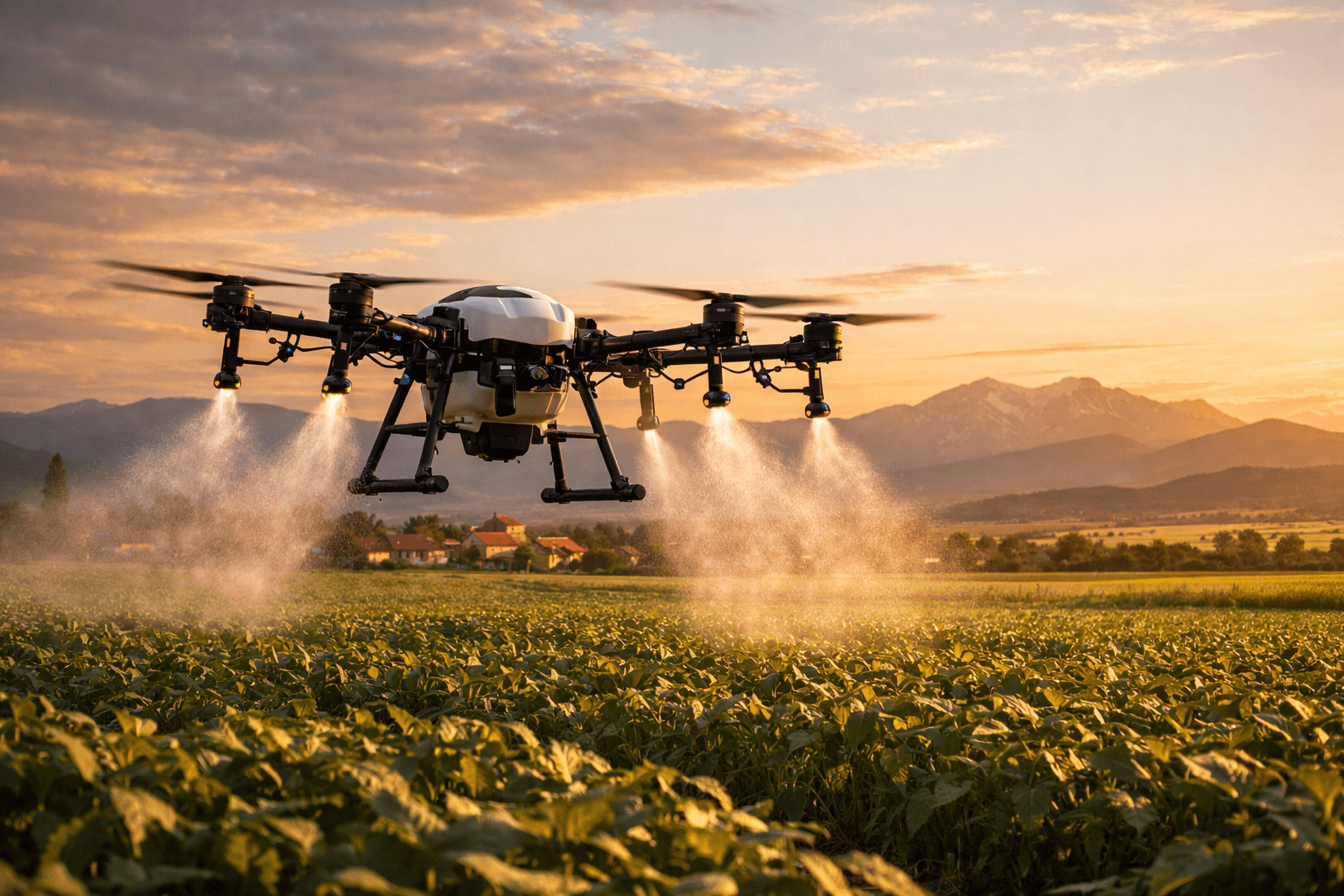
The drone flies at 2–3 metres above the crop and does not touch a single plant. Zero trampling means:
- 100% of the area yields a harvest
- No soil compaction
- Plants experience no mechanical stress
Conclusion: For expensive crops (sunflower, rapeseed, vegetables) the loss from trampling can exceed the price difference in treatment costs. The drone is the undisputed winner here. Learn more about the advantages of drones in agriculture.
Spraying Precision
Tractor Sprayer
Tractor sprayers rely on pressure and nozzles mounted on a boom. The main challenges are:
- Uneven coverage in wind
- Overlap or gaps at turns
- Difficult flow rate calibration
- Terrain dependence – on hilly terrain height is not constant
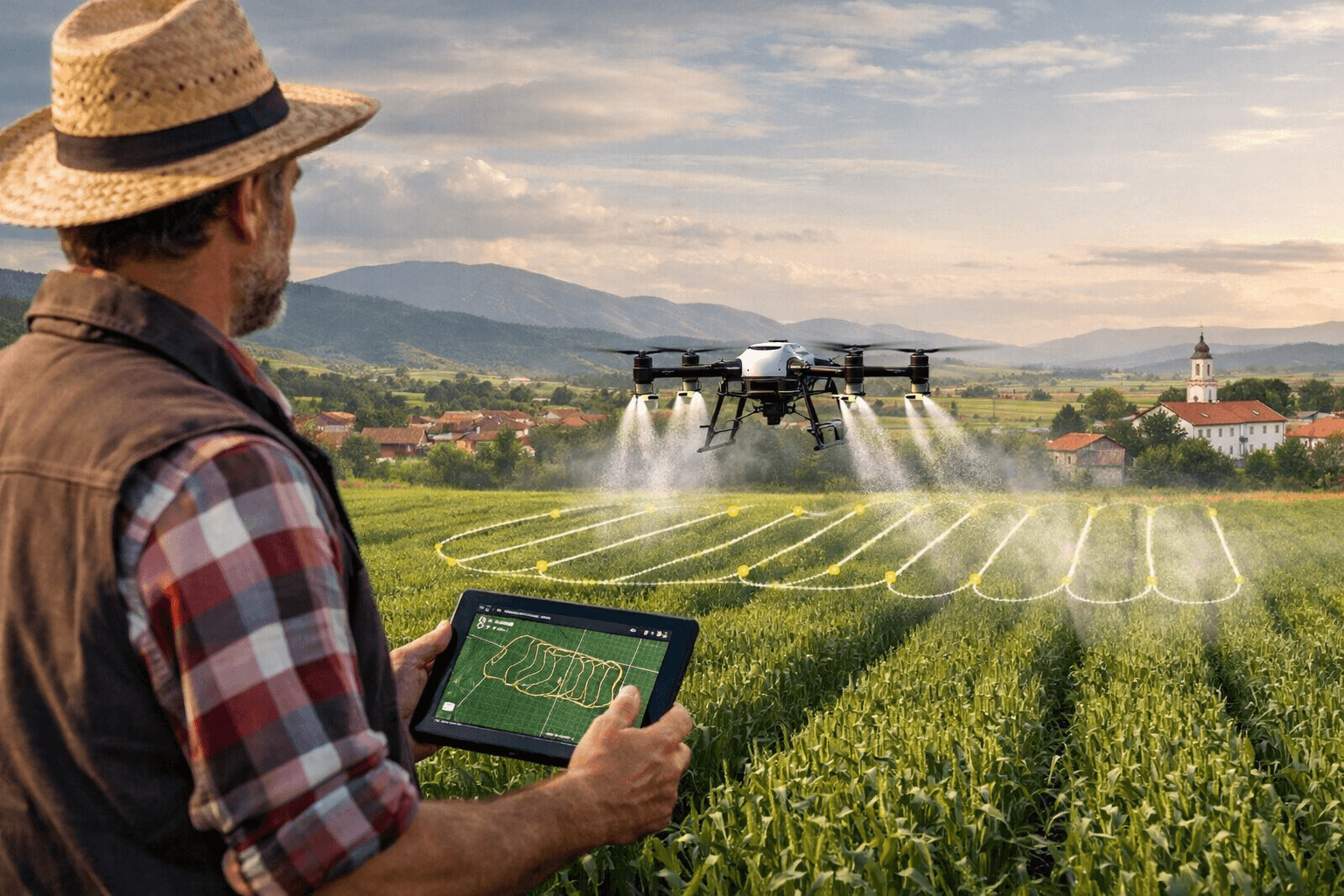
Drone DJI Agras T50
Modern agri drones offer:
- RTK GPS accuracy to 1–2 cm
- Automatic Terrain Following
- Centrifugal nozzles with adjustable droplet size
- Obstacle avoidance radar
- Constant height relative to the crop, regardless of topography
The result is uniform coverage of every plant – neither more nor less than needed. This is key for preparation efficiency and for environmental protection.
Conclusion: The drone provides significantly higher precision, especially on uneven terrain.
Flexibility Under Poor Conditions and Different Terrains
Access to Difficult Terrain
A tractor cannot enter:
- Steep hilly plots
- Waterlogged or wet fields (after rain)
- Vineyards, orchards, small plots with irregular shapes
The drone flies over all of this without problem. It is the only solution for many terrains in the mountain and sub-mountain areas of Bulgaria – from the hilly vineyards around Pazardzhik and Haskovo to the steep orchards at the foot of the Rhodopes.
Operation in Various Weather
Tractor treatments are limited by:
- Wet soil after rain (getting stuck, tracks)
- Strong wind (spray drift)
- Daylight hours
The drone can work at night too, when the wind is usually weakest. In light dew, coverage is even better. Its only limitation is strong wind above 6 m/s – but at such wind, tractor spraying is also ineffective.
Conclusion: The drone is significantly more flexible and accessible for different terrains and conditions.
Water Use – Critical Difference
| Parameter | Tractor | Drone | | -------------------------- | ------------------ | -------------- | | Water per decare | 15–30 litres | 1–2 litres | | Water needed for 1,000 dka | 15,000–30,000 L | 1,000–2,000 L | | Water transport | Heavy, costly | Minimal | | Logistics | Water tanker, pump | 20-L canisters |
In drought or limited water access conditions – which is a reality for many farms in Southern Bulgaria, including the Plovdiv, Stara Zagora, Pazardzhik and Haskovo areas – the drone is the only practical solution. Farmers in the Thracian Plain and Dobrudzha increasingly choose drone spraying precisely because of minimal water use. With 5–10 times less water you achieve the same or better coverage.
Preparation Savings – Up to 30% Economy
The precision centrifugal nozzles of the DJI Agras T50 create fine droplets of optimal size that uniformly cover the leaf mass. Combined with the airflow from the rotors (downwash effect), the preparation also reaches the underside of the leaves.
The result:
- Up to 30% less chemicals at the same effectiveness
- Better penetration in dense stands
- Reduced contamination of soil and water
For the Bulgarian farmer who spends thousands of BGN per year on preparations, 30% savings is a significant sum.
When the Tractor Is Still the Better Choice
Objectivity requires noting the situations in which the tractor retains its advantage:
- Very large, flat areas (over 5,000 dka) with established infrastructure – the tractor is familiar and organisationally easier for farms with an existing equipment fleet.
- Application of liquid fertilisers at high doses (over 30 L/dka) – the drone is not suitable for large liquid volumes.
- Herbicide treatment before sowing on bare areas – when there is nothing to trample, the drone's advantage is smaller.
- Own machinery available – if you already have a tractor and sprayer, marginal spraying costs are low.
When the Drone Is Categorically the Better Choice
- For crops over 50 cm tall (wheat, maize, sunflower) – no trampling
- On hilly or difficult terrain
- On small and medium plots with irregular shapes
- When urgent treatment of a large area is needed in a short time
- With limited water access
- In vineyards and orchards
- For night spraying for better effectiveness
- When precise, GPS-guided spraying is desired
More about our services with an agri drone can be found on our website.
Summary Table: Drone vs Tractor
| Criterion | Drone | Tractor | | ------------------- | ---------- | ---------- | | Speed | ⭐⭐⭐⭐⭐ | ⭐⭐ | | Price per decare | ⭐⭐⭐⭐ | ⭐⭐⭐ | | Precision | ⭐⭐⭐⭐⭐ | ⭐⭐⭐ | | No trampling | ⭐⭐⭐⭐⭐ | ⭐ | | Terrain access | ⭐⭐⭐⭐⭐ | ⭐⭐ | | Water use | ⭐⭐⭐⭐⭐ | ⭐⭐ | | Preparation savings | ⭐⭐⭐⭐⭐ | ⭐⭐⭐ | | Large liquid volume | ⭐⭐ | ⭐⭐⭐⭐⭐ | | Night operation | ⭐⭐⭐⭐⭐ | ⭐ |
Frequently Asked Questions
Which is faster for spraying – drone or tractor?
The drone is significantly faster. The DJI Agras T50 treats up to 210 decares per hour, and daily productivity reaches 1,500–3,000 decares. The tractor with a sprayer treats an average of 200–400 decares per day – meaning the drone is 5 to 10 times faster. This is critical for emergency treatments in the Plovdiv, Stara Zagora or Dobrudzha area when the treatment window is limited.
How much does drone spraying cost compared to tractor spraying per decare?
Tractor spraying costs 3–6 BGN/dka, and drone spraying – 4–8 BGN/dka. But when you add saved preparations (up to 30%), 5–10 times less water and zero trampling losses (3–5% with a tractor), the drone often works out more cost-effective. See current drone spraying prices.
Can the drone spray on uneven terrain and hilly fields?
Yes. The DJI Agras T50 features a Terrain Following radar that automatically maintains a constant height above the crop – even on hilly plots around Pazardzhik, Haskovo or in the Thracian Plain. The tractor is severely limited on slopes and wet terrain.
Does the drone trample crops when spraying?
No. The drone flies at 2–3 metres above the crop and does not touch a single plant. Unlike the tractor, which tramples 3–5% of the area with every pass. For 1,000 decares of wheat this can mean 30–50 dka of lost harvest.
When is it better to choose a tractor instead of a drone?
A tractor is more suitable when: very large flat areas (over 5,000 dka) with an existing machinery fleet, application of liquid fertilisers at doses above 30 L/dka and herbicide treatment before sowing on bare areas. For all other scenarios – especially for crop protection of actively growing crops – the drone is the better solution.
Conclusion
The debate "drone or tractor for spraying" has no universal answer, but the data are categorical: for most scenarios in Bulgarian agriculture the drone offers a better quality-to-price ratio. Faster, more precise, without trampling, with less water and fewer chemicals – this is not the future but the present of crop protection.
The tractor retains its role with very large areas and an existing machinery fleet and for applications of high liquid volumes. But for spraying and foliar fertilisation, the drone is the technological leader.
Request a Free Consultation from AirAgro
Not sure whether the drone is the right choice for your farm? AirAgro offers a free consultation and farm inspection to determine together the most effective approach for your areas.
We work with the DJI Agras T50 and serve farms throughout Bulgaria – from the plains of Dobrudzha to the fields of the Thracian Plain, including the areas of Plovdiv, Stara Zagora, Pazardzhik and Haskovo.
What we offer:
- 🌾 Free consultation – we analyse your needs and areas
- 🚁 Drone demonstration – see the DJI Agras T50 in action on your field
- 📋 Individual treatment plan – we prepare a programme for the entire season
- 💰 Personal quote – exact price for your decares and crops
📞 Call now or complete the contact form to request a free farm inspection. See our drone spraying services and current prices.