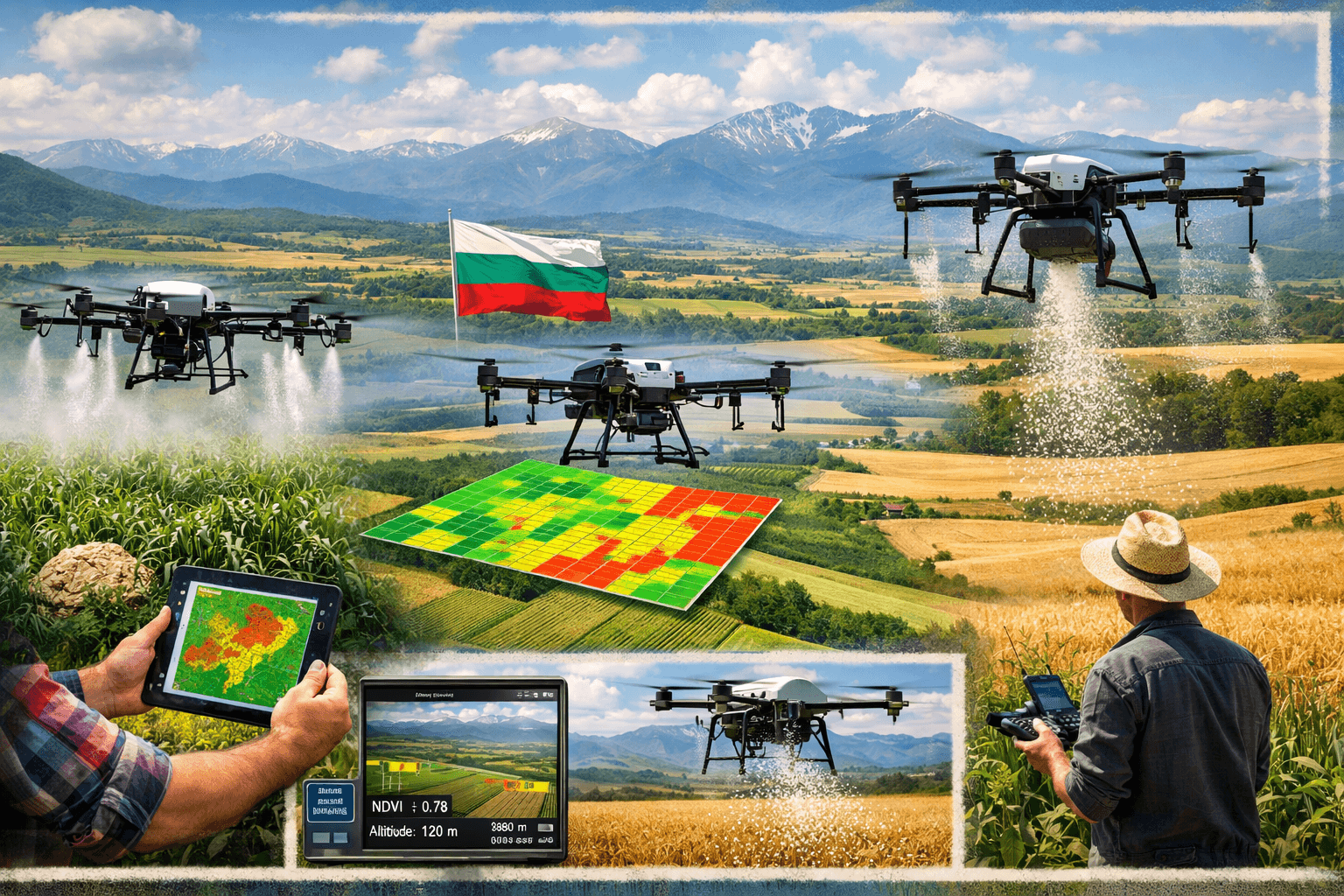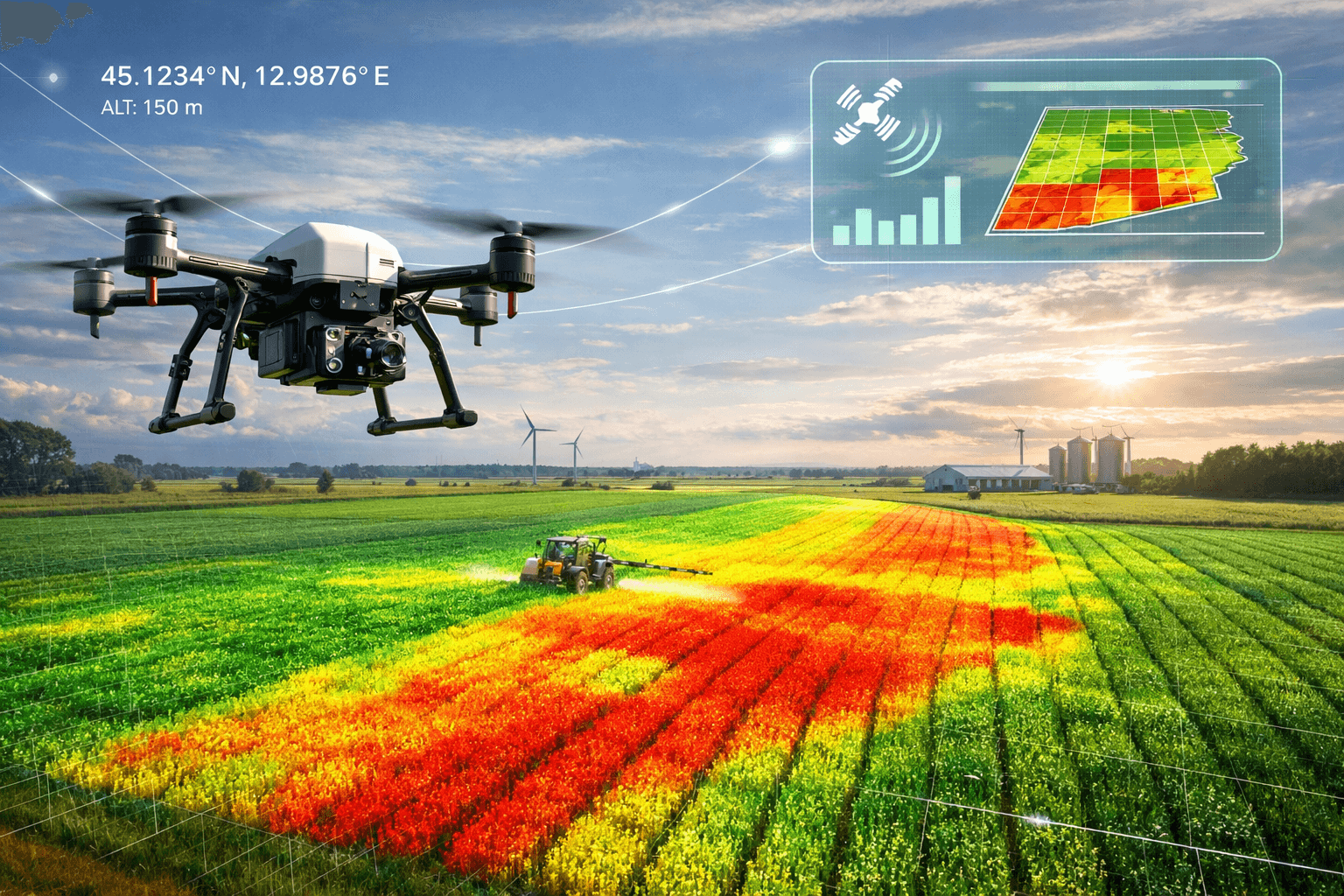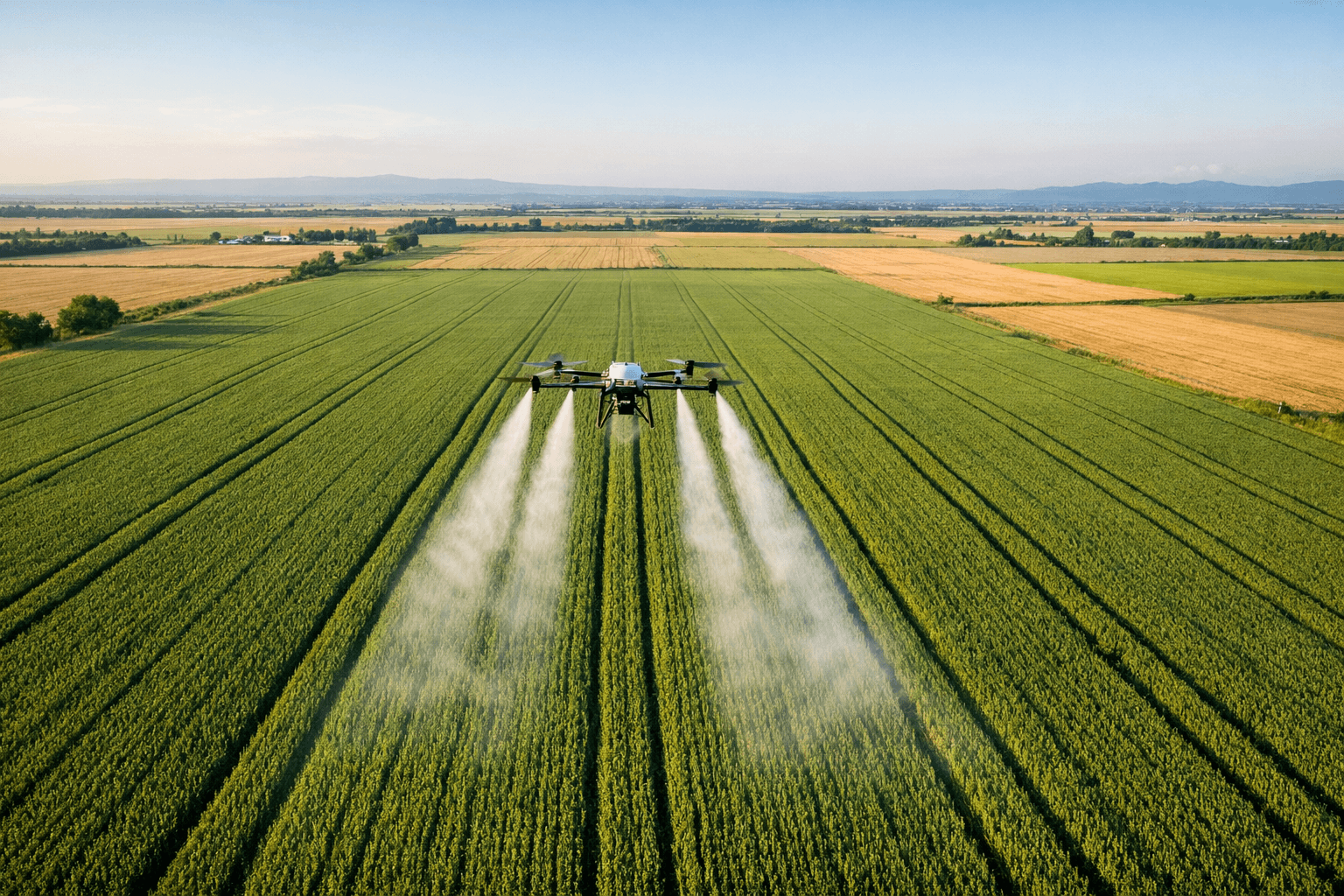
How Many Decares Does a Drone Spray Per Day – Real Data
One of the first questions every farmer asks is: "How many decares does a drone spray per day?" The answer determines whether this technology is practical for their farm – whether the drone can replace or complement their existing machinery.
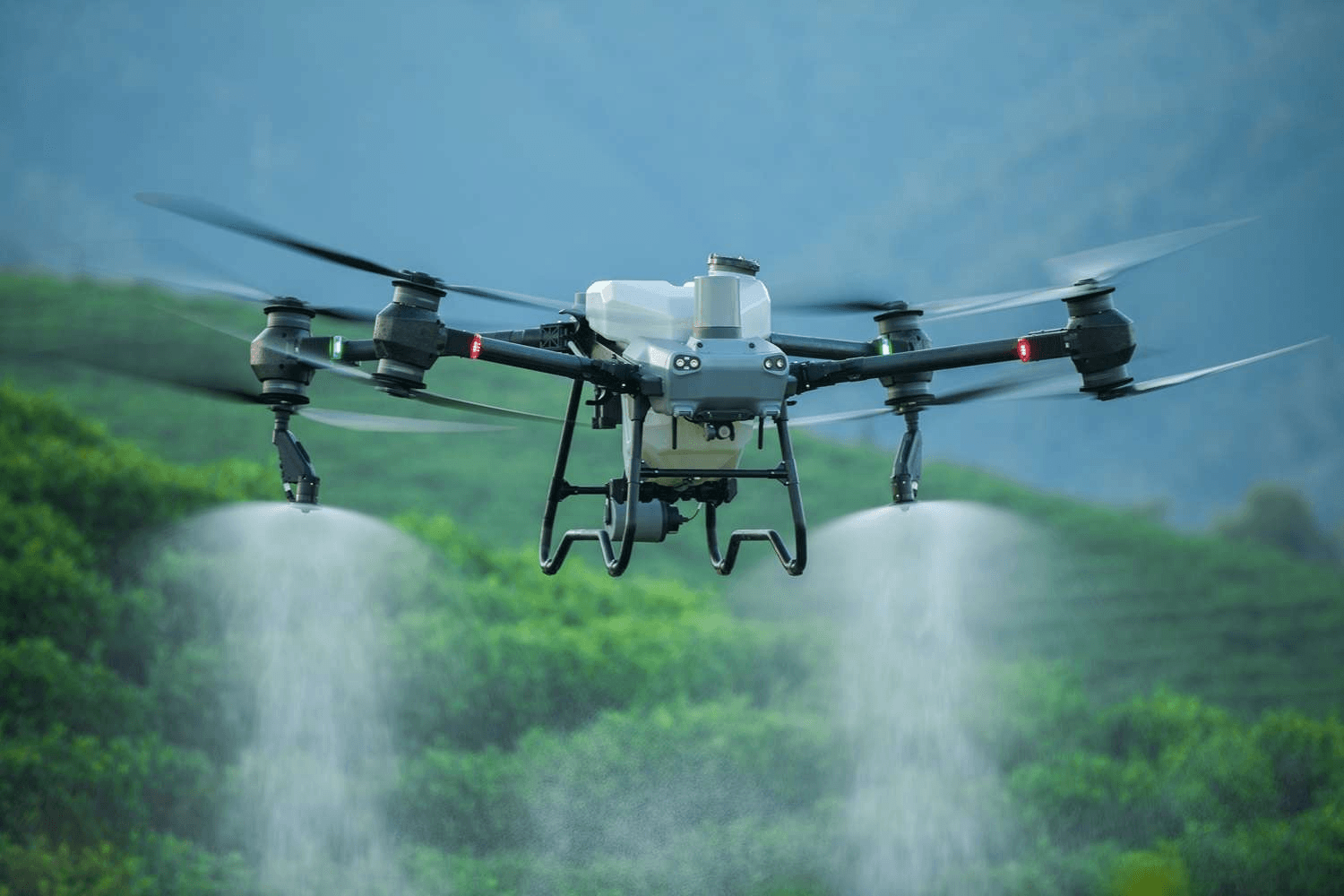
In this article we present real data on the productivity of the DJI Agras T50 – the agricultural drone used by the AirAgro team. No marketing exaggerations – only specific figures from field conditions in Bulgaria.
Technical Capacity of the DJI Agras T50
Before discussing daily productivity, let us look at the technical parameters that determine it:
| Parameter | Value | | ------------------------ | -------------------------------- | | Tank volume | 40 litres | | Maximum strip width | 11 metres | | Maximum operating speed | 15 m/s | | Theoretical productivity | up to 210 dka/hour (21 ha/hour) | | Battery swap time | 2–3 minutes | | Preparation refill time | 1–2 minutes | | Working time per battery | 8–12 minutes (depending on load) |
The productivity of 210 decares per hour is the maximum value under ideal conditions – a large, rectangular field with low dosage. In actual practice the figures are different and depend on many factors.
Actual Daily Productivity
Daily capacity of the DJI Agras T50: 700–1,000 decares during a standard working day with a single operator and arable crops. With extended work (including night flying) and optimal logistics, capacity reaches 2,000–3,000 decares.
Optimistic Scenario: 2,500–3,000 Decares per Day
This result is achieved with:
- Large, rectangular parcels (over 200 dka each)
- Low dosage (1–1.5 L/dka working solution)
- Short distance between parcels
- Good logistics organisation (preparation ready, batteries charged)
- Working day of 10–12 hours (including night flying)
- Weak to moderate wind
Realistic Scenario: 1,500–2,000 Decares per Day
The most frequent result under normal field conditions:
- Medium-sized parcels (50–200 dka)
- Standard dosage (1.5–2 L/dka)
- Moderate distance between fields
- Working day of 8–10 hours
- Normal meteorological conditions
Conservative Scenario: 800–1,500 Decares per Day
Under more difficult conditions:
- Small or irregular parcels (under 50 dka)
- High dosage (2–3 L/dka)
- Parcels spread out (transport time)
- Strong wind (work pauses)
- Orchards or vineyards (slower mode)
- Working day of 6–8 hours
What Determines How Many Decares a Drone Sprays
1. Parcel Size and Shape
This is the most important factor. With large, rectangular fields the drone makes long, uninterrupted strips with a minimum number of turns. With small, irregular parcels the time for turns, manoeuvres and re-configuration increases significantly.
Example:
- Field of 500 dka, rectangular → treatment in ~30 minutes of effective flight
- 10 parcels of 50 dka each, scattered → treatment in 2–3 hours (including re-configuration)
2. Dosage (Volume per Decare)
Dosage determines how often the drone stops for refilling. At 1 L/dka the 40-litre tank covers 40 decares. At 2 L/dka – 20 decares.
| Dosage | Decares per fill | Stops per 1,000 dka | | --------- | ---------------- | ------------------- | | 1 L/dka | 40 dka | 25 times | | 1.5 L/dka | 27 dka | 37 times | | 2 L/dka | 20 dka | 50 times | | 3 L/dka | 13 dka | 77 times |
Each refilling stop takes 2–4 minutes. With 50 stops that is 100–200 minutes just for loading. This is why logistics is so important.
3. Meteorological Conditions
- Wind up to 3 m/s – ideal conditions, full speed
- Wind 3–5 m/s – slightly reduced effectiveness, normal operation
- Wind 5–6 m/s – reduced speed, narrower strip width
- Wind above 6 m/s – work stops
Rain is an absolute contraindication – not because of the drone, but because spraying is ineffective on wet leaves.
4. Logistics and Organisation
Good organisation can increase daily productivity by 30–50%:
- Pre-prepared working solution
- Sufficient number of charged batteries (minimum 6)
- Vehicle with close field access
- Coordination between operator and assistant
5. Crop Type and Terrain
Different crops require different approaches to crop protection:
- Cereals (wheat, barley) – standard mode, maximum productivity. Ideal for fungicide treatment and herbicide spraying of large areas in Dobrudzha and the Thracian Plain
- Corn – taller crop, slower mode for better penetration during insecticide treatment
- Vineyards – special mode, lower height, significantly slower. Popular for fungicide treatment of vineyards around Plovdiv and Stara Zagora
- Orchards – slowest mode, row by row
- Hilly terrain – automatic terrain following works excellently, but speed is reduced. Especially relevant for parcels around Pazardzhik and Haskovo
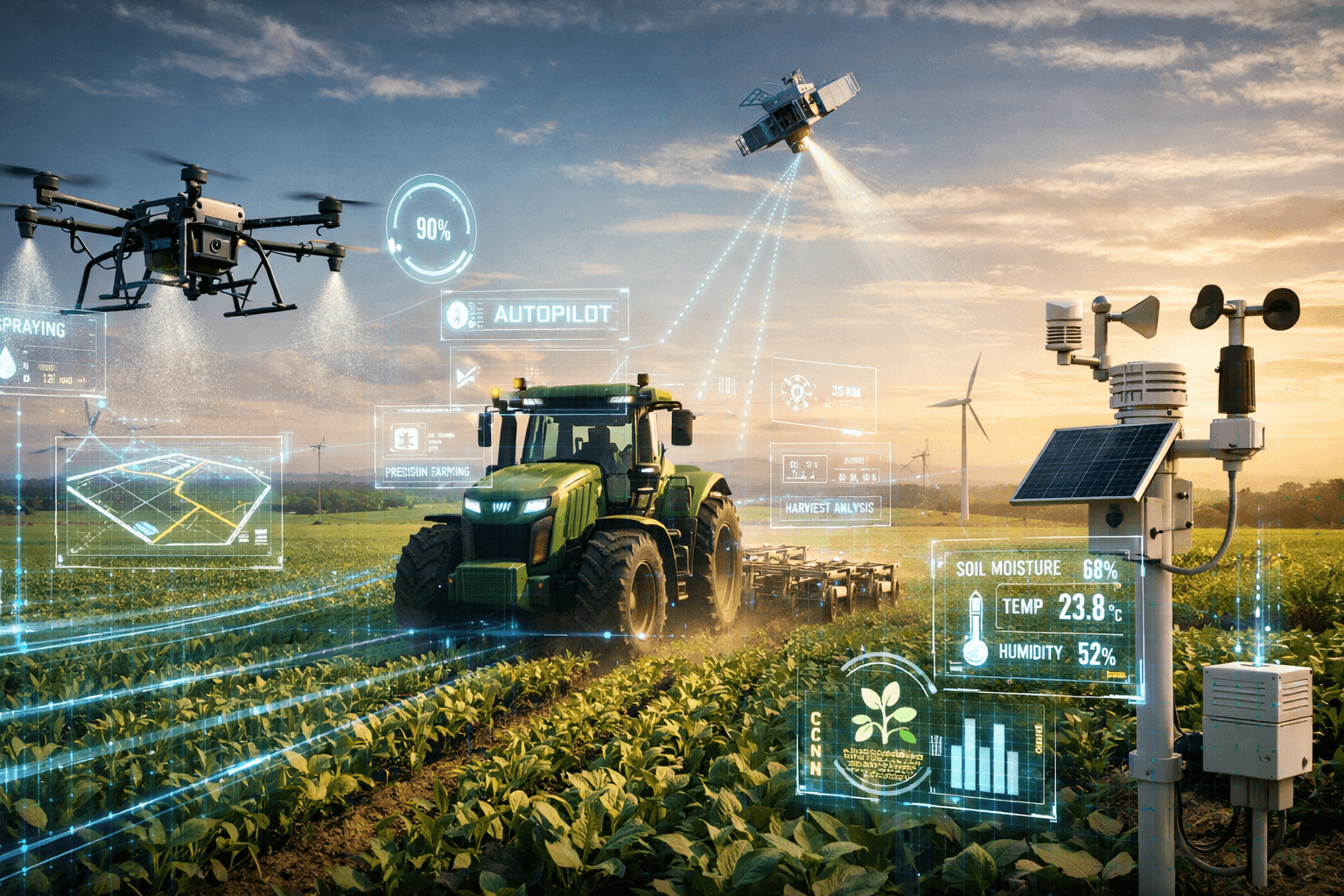
All these scenarios fall within the realm of precision agriculture, where the DJI Agras T50 excels in precision and efficiency.
Comparison with Tractor and Aircraft
| Parameter | Drone DJI T50 | Tractor with sprayer | Aerial spraying | | ---------------- | --------------- | -------------------- | --------------- | | Daily capacity | 1,500–3,000 dka | 200–400 dka | 3,000–8,000 dka | | Precision | Very high | Medium | Low | | Trampling | None | 3–5% | None | | Minimum area | 5 dka | 20 dka | 500 dka | | Night work | Yes | Limited | No | | Water per decare | 1–2 L | 15–30 L | 3–5 L |
As you can see, the drone occupies the middle position by capacity – significantly faster than the tractor, but slower than aerial chemical spraying. The difference is that the drone combines high speed with excellent precision and zero trampling.
For a detailed comparison with the tractor see our article on drone or tractor for spraying.
How AirAgro Achieves Maximum Productivity
The AirAgro team applies a series of practices to optimise daily capacity for crop protection and precision agriculture:
Planning: Before going to the field, routes are planned in advance with DJI software. GPS coordinates of the parcel are entered from the office, saving valuable time in the field.
Logistics: We carry sufficient batteries, pre-prepared working solution and spare parts. The vehicle is specially equipped for rapid operation.
Efficient sequencing: Parcels are processed in optimal order – from nearest to furthest, or in groups in one district.
Night work: When conditions allow, we also work after sunset. The DJI Agras T50 is fully equipped for night operation – LED lighting, radar and full autonomy. This extends the working day by 3–4 hours.
Regional expertise: We work actively in the areas of Plovdiv, Stara Zagora, Pazardzhik and Haskovo, as well as in Dobrudzha and the entire Thracian Plain. We know the specifics of local terrain, crops and climatic conditions, enabling us to achieve maximum efficiency in fungicide treatment, herbicide spraying and insecticide treatment.
Frequently Asked Questions
How many decares can a drone spray per hour?
The DJI Agras T50 achieves up to 210 decares per hour under optimal conditions. The real average is 100–150 decares per hour accounting for turns, refilling and manoeuvres.
How many fields can the drone treat in a day?
Depends on their size and distance between them. Typically – 5 to 15 parcels per day at average size of 100–200 dka.
How much does treatment of 1 decare cost?
The price varies between 4 and 8 BGN/dka depending on volume, crop and preparation. For a specific offer see drone spraying prices.
Can the drone work in rain?
No – not because of the machine, but because spraying is ineffective on wet leaves. Rain washes the preparation off before it is absorbed.
Is there a minimum area for drone spraying?
There is no strict limitation – we work with areas from 10 decares upwards. For smaller farms we offer the option of combining neighbouring areas for more favourable conditions. The DJI Agras T50 is effective even for small and irregular parcels thanks to RTK navigation and automatic route planning.
How the Entire Process Works
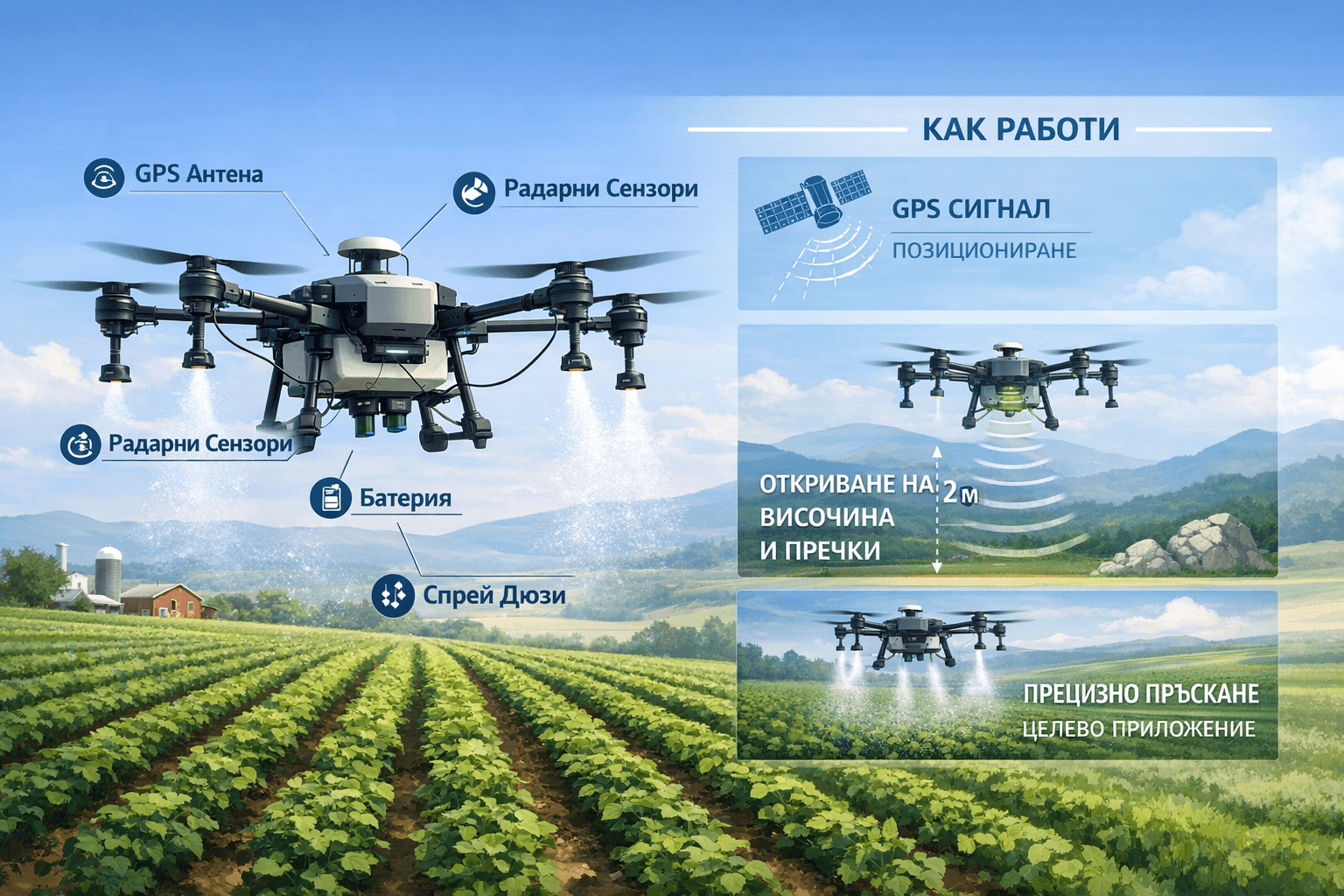
If you are interested in the details of the process – from planning to the actual spraying – read our article on how an agricultural drone works. There we explain step by step what happens when our team comes to your field.
Conclusion
How many decares does a drone spray per day? The answer is: 1,500–3,000 decares with the DJI Agras T50 under normal conditions. This is 5–10 times more than a tractor and fully sufficient for servicing medium and large farms.
The key is in proper organisation. With an experienced team, good logistics and modern equipment, the drone can treat your areas quickly, precisely and without a single trampled plant.
Order Spraying from AirAgro
Want to find out how quickly we can treat your areas? AirAgro works with the DJI Agras T50 and offers professional services for crop protection – including fungicide treatment, herbicide spraying and insecticide treatment in the areas of Plovdiv, Stara Zagora, Pazardzhik, Haskovo, Dobrudzha and the Thracian Plain.
Order now:
- 🌾 Free consultation – we calculate exactly how long treatment of your parcels will take
- 🚁 Drone demonstration – see the DJI Agras T50 in action on your field
- 📋 Treatment plan – individual programme for precision agriculture for the entire season
- 📉 Farm inspection – we assess the parcels and optimise routes
📞 Call now for a free consultation and treatment planning. See our professional drone spraying services and current prices.