Herbicide Spraying of Corn – Guide for Farmers
Herbicide spraying of corn is a critical step in the cultivation technology, on which the final yield largely depends. Corn is a crop with slow initial development – during the first 4–6 weeks after emergence it is extremely vulnerable to competition from weeds. If weeds are not controlled in time, yield losses can reach 50% and above.
In this article we will look at the main weeds in corn fields in Bulgaria, herbicide treatment strategies (pre-emergence and post-emergence), suitable spraying times and why drone technology is the optimal solution for herbicide treatment of corn.
Main Weeds in Corn Fields
Understanding the main weeds is the foundation for the correct choice of herbicide strategy. In Bulgarian corn fields the following species are most commonly encountered.
Annual Grass Weeds
Johnsongrass (Sorghum halepense) – from seeds. Johnsongrass is one of the most aggressive weeds in corn. Its young plants resemble corn plants, making early detection difficult. It competes strongly with corn for water and nutrients, especially in dry years.
Barnyard grass (Echinochloa crus-galli) – a widely distributed annual grass weed found in almost every corn field. It develops rapidly in warm and wet conditions and can reach considerable height.
Crabgrass (Digitaria sanguinalis) – primarily in the warmer southern regions of the country, including the Thracian Plain (Plovdiv, Pazardzhik, Stara Zagora, Haskovo). It forms dense tufts and is difficult to control after maturation.
Broad-Leaved Weeds
Redroot pigweed (Amaranthus retroflexus) – one of the most mass broad-leaved weeds in corn. It produces enormous quantities of seeds (up to 500,000 per plant) and rapidly infests fields. Populations with resistance to certain herbicides have been observed in recent years.
Lambsquarters (Chenopodium album) – another extremely widespread broad-leaved weed. Hardy and adaptive, it is found from the lowlands to the mountain areas. It competes strongly with corn for light and nutrients.
Black nightshade (Solanum nigrum) – especially problematic in wet years. Not as competitive as pigweed, but can hinder harvesting.
Jimsonweed (Datura stramonium) – an annual broad-leaved weed with rapid growth that can overtop corn. All parts of the plant are poisonous.
Perennial Weeds
Rhizome johnsongrass (Sorghum halepense) from rhizomes – considerably harder to control than seed-propagated plants. Rhizomes can reach a depth of 30–40 cm and survive winter. It requires specialised herbicides and a systematic approach for control.
Field bindweed (Convolvulus arvensis) – a creeping perennial weed with a deep root system. Extremely difficult to completely eradicate. It twines around corn stalks and drags them down.
Herbicide Spraying Strategies for Corn
In herbicide spraying of corn there are two main approaches, which can be applied individually or in combination.
Pre-Emergence Herbicide Treatment
Pre-emergence herbicides are applied after sowing but before emergence of corn and weeds. They act through the soil, forming a protective "barrier" layer that prevents germination of weed seeds.
Advantages of pre-emergence treatment:
- Weeds are controlled before they can compete with corn
- Applied in one pass, before the field becomes difficult to access
- Broad spectrum of action against annual grass and broad-leaved weeds
Limitations:
- Effectiveness depends on soil moisture – in a dry spring, action may be weak
- Does not control perennial weeds from rhizomes
- Requires an even soil surface for good effect
Typical active substances for pre-emergence treatment in corn include S-metolachlor, acetochlor, dimethenamid-P (for grass weeds) in combination with terbuthylazine, mesotrione or isoxaflutole (for broad-leaved weeds).
Post-Emergence Herbicide Treatment
Post-emergence herbicides are applied when corn and weeds have already emerged. The advantage is that you can see the actual weed situation and respond in a targeted manner.
Optimal timing: Corn should be at the 2–6 leaf stage (BBCH 12–16), and weeds should be young – at the 2–4 leaf stage for broad-leaved weeds and up to tillering for grass weeds.
Active substances for post-emergence treatment:
- Against broad-leaved weeds: nicosulfuron, mesotrione, topramezone, dicamba, tembotrione
- Against grass weeds: nicosulfuron (combined effect), cycloxydim, haloxyfop-R-methyl (only against grass weeds)
- Broad-spectrum solutions: rimsulfuron + nicosulfuron, mesotrione + nicosulfuron
Combined Approach
Many experienced farmers prefer a combined strategy: pre-emergence herbicide for early control of annual weeds, followed by post-emergence treatment for control of escaped weeds and perennial species. More about the overall approach can be found in our article on corn drone spraying.
Why Drone Spraying Is Ideal for Corn
Corn is a crop where drone spraying most fully demonstrates its advantages. Here is why an increasing number of farmers in Bulgaria are choosing drone spraying services for their corn fields.
No Crop Trampling
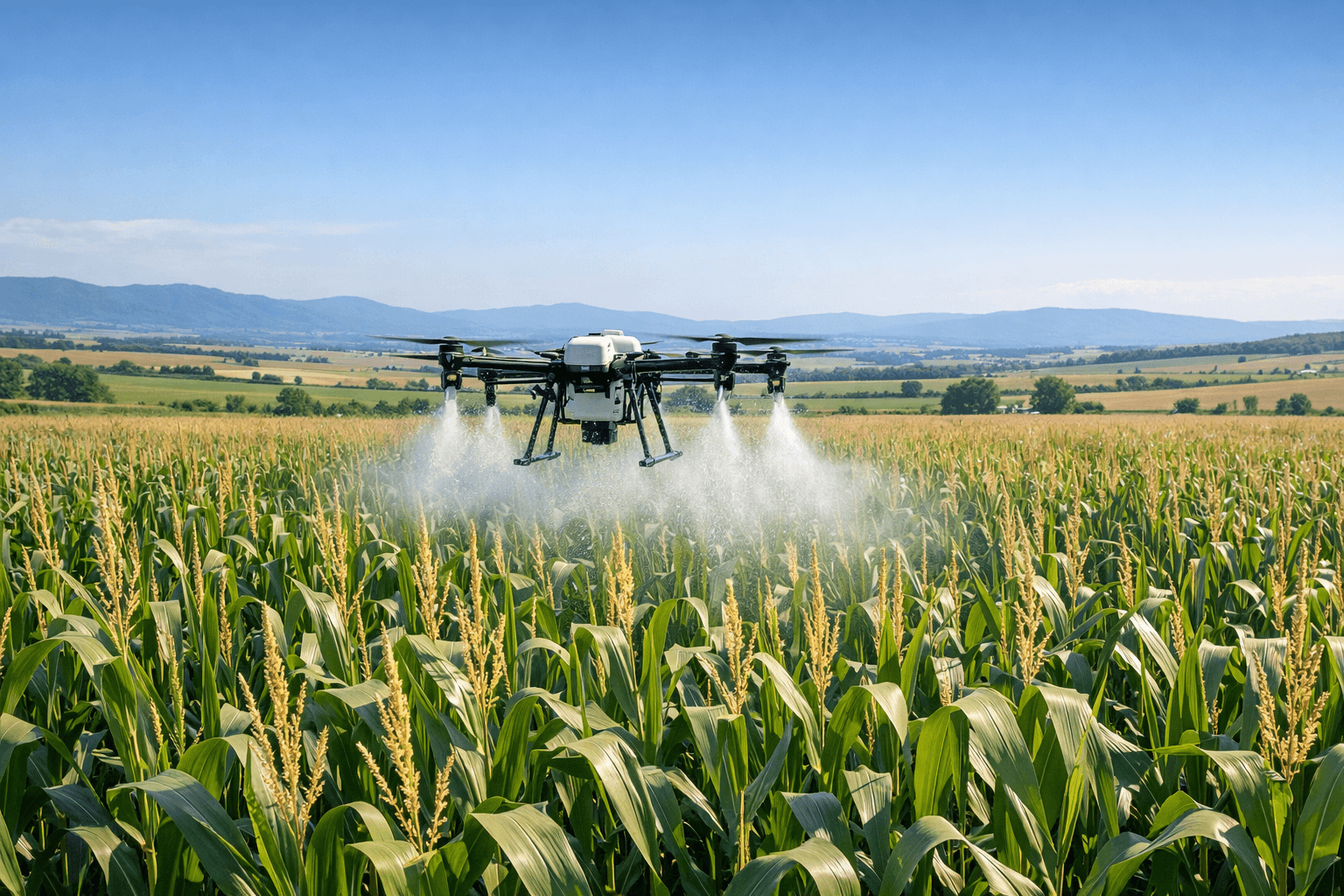
When corn passes the 6–8 leaf stage and begins rapid growth, entry of ground machinery inevitably tramples plants along technology tracks and turns at field edges. In the drone vs tractor comparison – the drone wins categorically in this respect: zero loss of plants from mechanical damage.
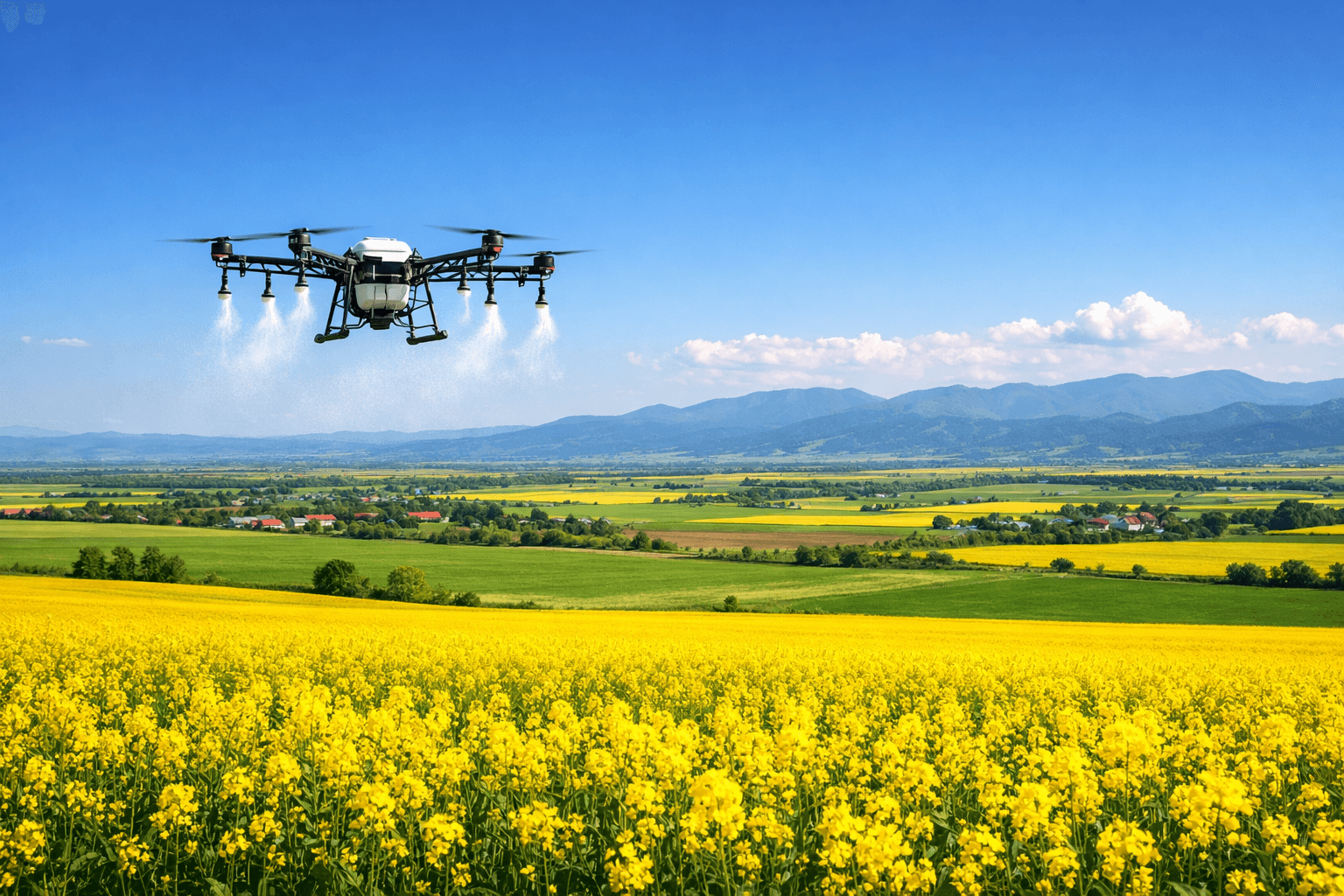
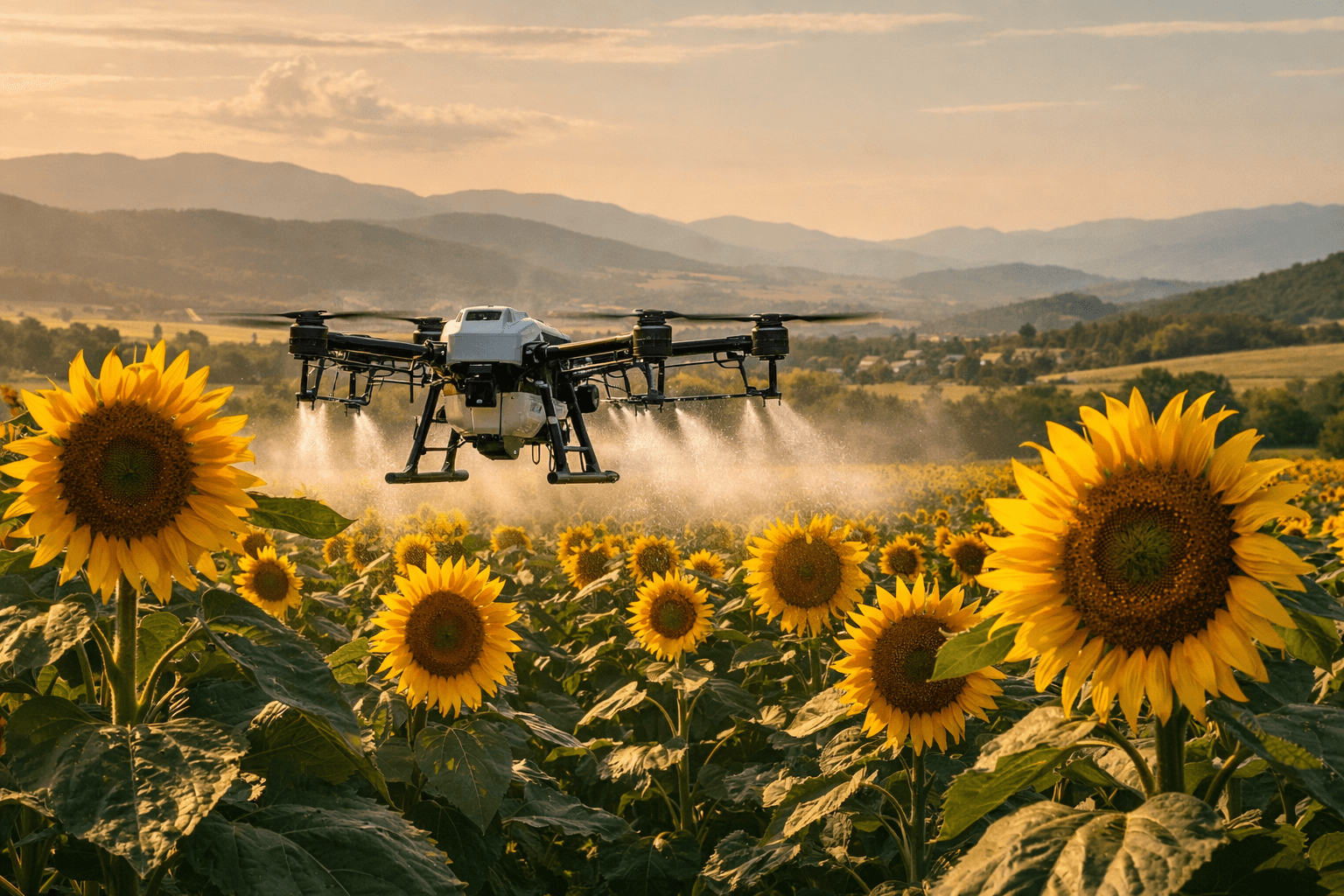
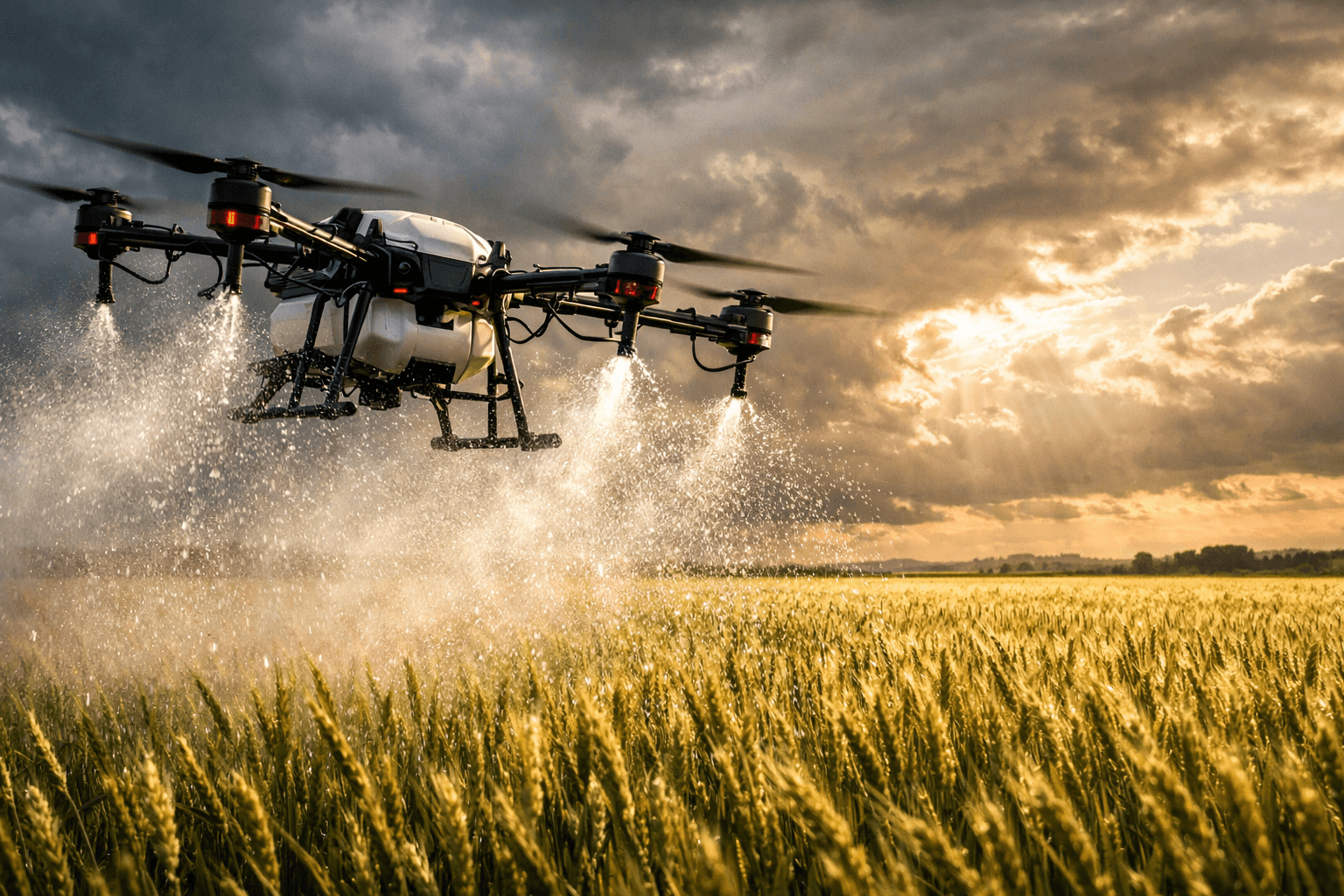
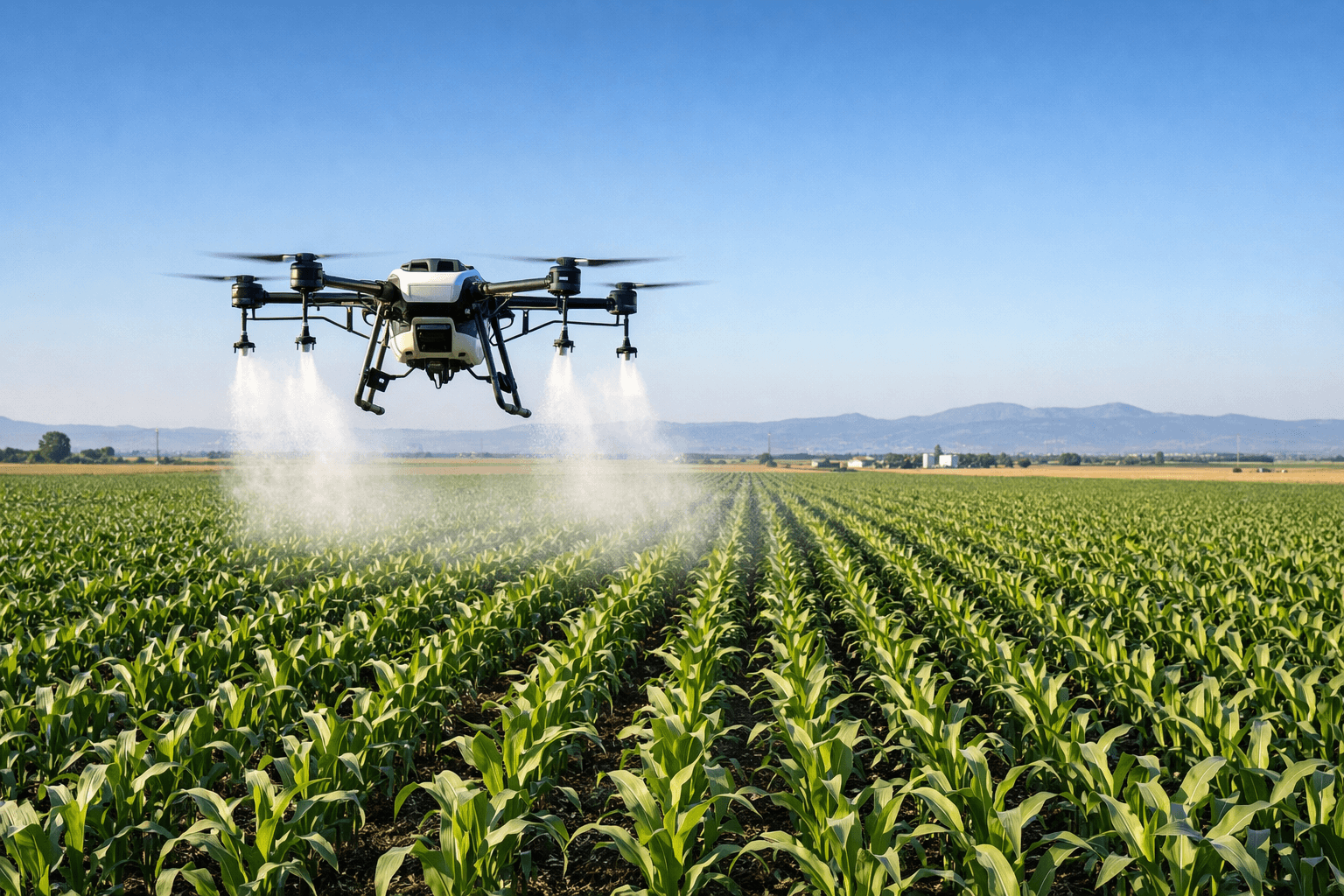
The DJI Agras T50 drone flies at a height of 2–3 metres above the crop and applies the preparation without any physical contact with the plants. With tall corn (over 1.5 m), ground spraying is already practically impossible without specialised high-clearance sprayers, while the drone operates without limitation from crop height.
Wet Soil Access
Spring and early summer months in Bulgaria are often characterised by intense rainfall. Wet soil makes fields impassable for heavy machinery. With the drone, spraying continues regardless of terrain condition. This is especially important for post-emergence herbicide treatments, where a delay of even 5–7 days can make treatment ineffective – weeds outgrow their optimal stage.
Precision and Uniformity
The DJI Agras T50 works with RTK GPS navigation, providing strip accuracy of ±10 cm. In practice this means perfectly uniform coverage without gaps and overlaps. The automatic flow control system regulates the amount of preparation relative to the drone's speed, guaranteeing the correct dose on every square metre.
High Productivity
With productivity of over 200 decares per hour, the DJI Agras T50 enables treatment of large corn blocks within the optimal spraying window. A single machine can treat 1,500–2,000 decares per day, which is comparable to a high-performance self-propelled sprayer, but without soil compaction and crop trampling.
Practical Tips for Herbicide Treatment of Corn
Corn is grown widely across Bulgaria – from Dobrudzha in the north to the Thracian Plain in the south. In the areas of Plovdiv, Stara Zagora, Pazardzhik and Haskovo sowing is earlier (beginning of April), which also means an earlier window for herbicide treatment. In Dobrudzha the optimal timing is 2–3 weeks later.
Know the Weed Situation
Before choosing a herbicide, walk through the field and determine which weeds predominate. Different herbicides have different spectra of action – a universal solution does not exist.
Respect the Crop and Weed Growth Stage
The effectiveness of post-emergence herbicides directly depends on the development stage of the weeds. Young weeds (2–4 leaves) are controlled considerably more easily than mature ones (8+ leaves). Remember that corn also has tolerance to certain herbicides only in specific stages.
Be Careful with Temperatures
Most corn herbicides have an optimal temperature range for application – usually between 15 and 25 °C. At temperatures above 28–30 °C the risk of phytotoxicity to corn increases significantly. Spray early in the morning or in the evening.
Use Adjuvants
Adding a suitable sticker or wetting agent can significantly improve the effectiveness of the herbicide, especially in drone spraying with reduced water volume.
Plan Herbicide Rotation
Using the same herbicide year after year leads to the development of resistant weed populations. Rotate products with different mechanisms of action and combine chemical control with agrotechnical measures (crop rotation, inter-row cultivation).
Frequently Asked Questions
What is the optimal timing for herbicide spraying of corn?
For pre-emergence treatment – immediately after sowing, before emergence (April–May). For post-emergence treatment – when corn is at BBCH 12–16 (2–6 leaves) and weeds are in early stage (2–4 leaves). In the Thracian Plain the timing is 2–3 weeks earlier than in Dobrudzha.
What herbicide should I choose for my corn fields?
The choice depends on the weed situation. Against broad-leaved weeds (pigweed, lambsquarters, jimsonweed) – nicosulfuron, mesotrione, tembotrione. Against grass weeds (johnsongrass, barnyard grass) – nicosulfuron, cycloxydim. For complex control – combinations of nicosulfuron + mesotrione. Consult an agronomist for specific conditions. For weed control strategies in other crops, see our article on weed control in wheat.
Is herbicide drone spraying safe for corn?
Yes, drone spraying with the DJI Agras T50 is completely safe and even more gentle for the crop than ground spraying. The drone applies the preparation with precise GPS navigation without contact with the plants. No crop trampling, no soil compaction and no loss of productive area from technology tracks.
What should I do with resistant weeds in corn?
Resistance is a growing problem, especially with pigweed and johnsongrass. Rotate herbicides with different mechanisms of action, combine pre-emergence and post-emergence treatment, use crop rotation and inter-row cultivation.
How much does herbicide drone spraying of corn cost?
The price depends on area, location and specific requirements. At AirAgro we offer competitive prices that account for real savings – zero losses from trampling, no technology tracks and up to 30% less preparation consumption. See current drone spraying prices.
Conclusion
Herbicide spraying of corn requires the correct strategy, timely execution and consideration of the specific weed situation. Drone technology with the DJI Agras T50 offers unique advantages for this crop: zero trampling losses, access in any soil condition and precise preparation application.
📞 Request a free consultation for herbicide drone spraying of your corn fields. The AirAgro team offers:
- Free farm inspection with weed situation assessment
- Drone demonstration of the DJI Agras T50 on your field
- Individual treatment plan with herbicide selection for your conditions
We serve farms in the Thracian Plain, Dobrudzha and all of Bulgaria. Contact us at airagro.bg or call us – with weeds, every day's delay means lost yield!