How an Agricultural Drone Works – Explained Simply for Farmers
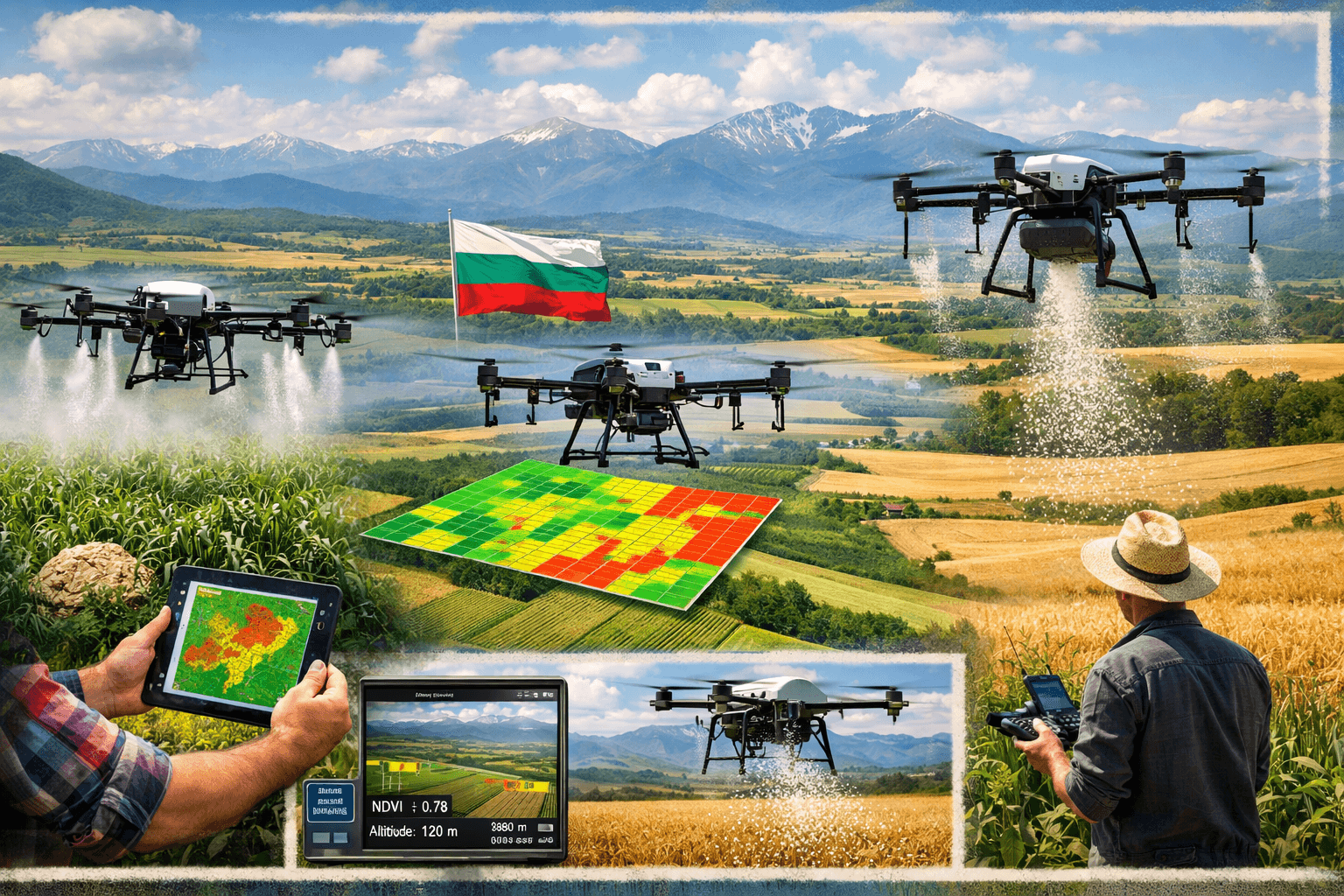
You have seen photos and videos of drones flying over fields and spraying. But how does an agricultural drone actually work? What happens from the moment our team arrives at the field to the moment the last decare is treated?
In this article we explain the entire process simply and clearly – without complex technical jargon. It is written for farmers who are considering using a drone for spraying and want to understand exactly what will happen in their field.
Step 1: The Operator Arrives at the Field
Everything starts with the arrival of a trained operator from the AirAgro team. He arrives in a fully equipped vehicle containing:
- Agricultural drone DJI Agras T50
- A set of batteries (at least 6–8 units)
- Charging station (works from a generator or mains power)
- The preparation to be applied (if provided by us)
- Clean water for the solution
- Tablet or controller
- Auxiliary equipment – measuring cans, jugs, graduated containers
The operator is certified and trained for work with agricultural drones. He has agronomic knowledge and can advise you on the optimal dosage and method of application.
Step 2: GPS Mapping of the Plot
Before the drone takes off, the operator must determine the exact boundaries of the field. This is done in two ways:
Method 1: Advance Planning (most common)
In most cases the plot boundaries are defined before going to the field. The operator uses satellite images in a specialised application (DJI Agras) and marks the corners of the plot. This saves time in the field.
Method 2: On-site Marking
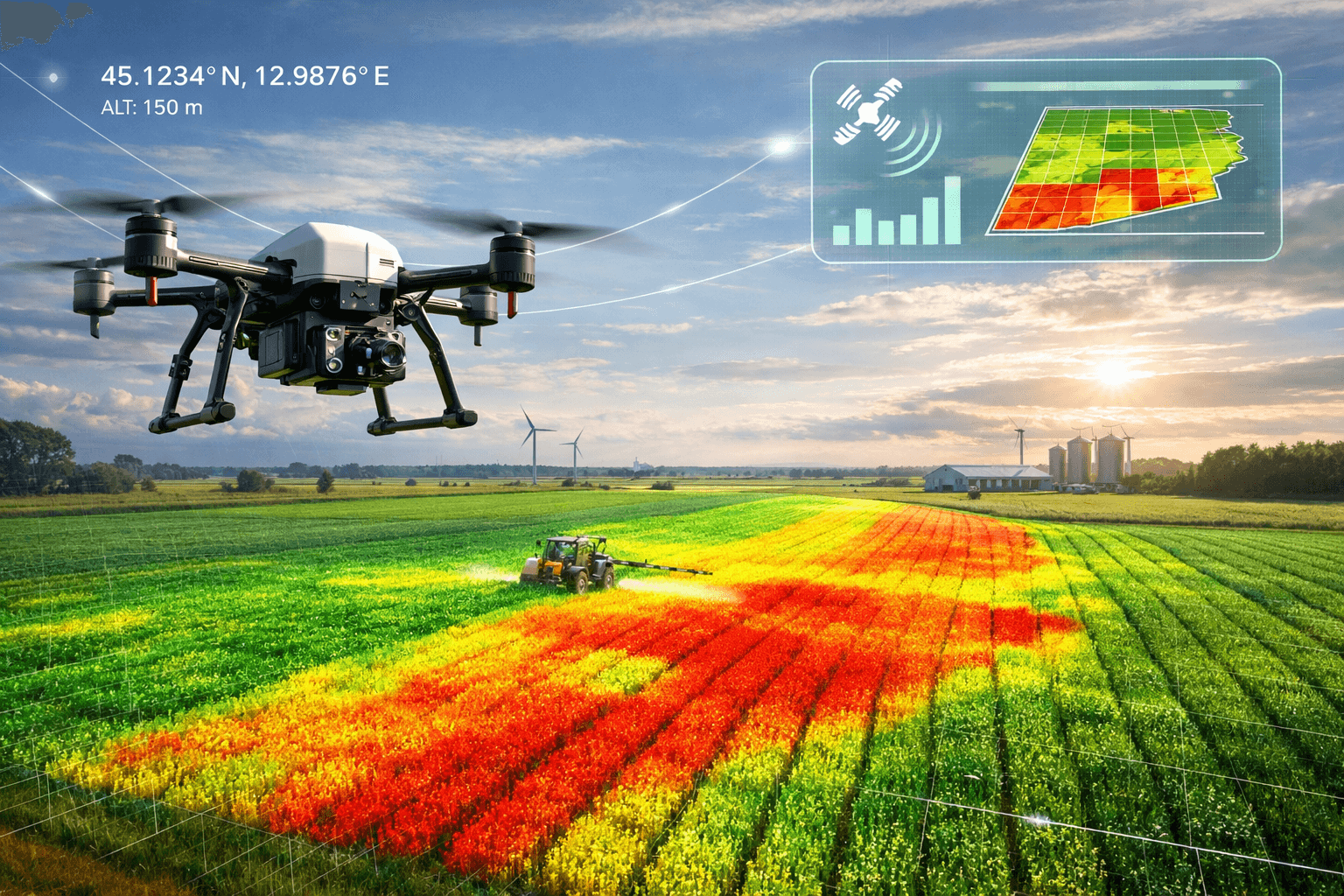
For new or complex plots the operator walks the boundaries with a GPS device or sends the drone to photograph them from above. Within a few minutes the system creates a precise map of the plot with centimetre accuracy.
This map includes:
- Exact field boundaries
- Obstacles (poles, trees, buildings)
- No-spray zones (water sources, roads)
- Terrain relief (hills, depressions)
Step 3: Flight Route Planning
Once the plot is mapped, the software automatically generates a spraying route. The operator sets:
- Strip width – how wide a strip the drone treats on each pass (typically 6–11 metres)
- Flight height – typically 2–3 metres above the crop
- Flight speed – 3 to 15 m/s, depending on the dosage
- Dosage – how many litres of solution per decare (1–3 L/dka)
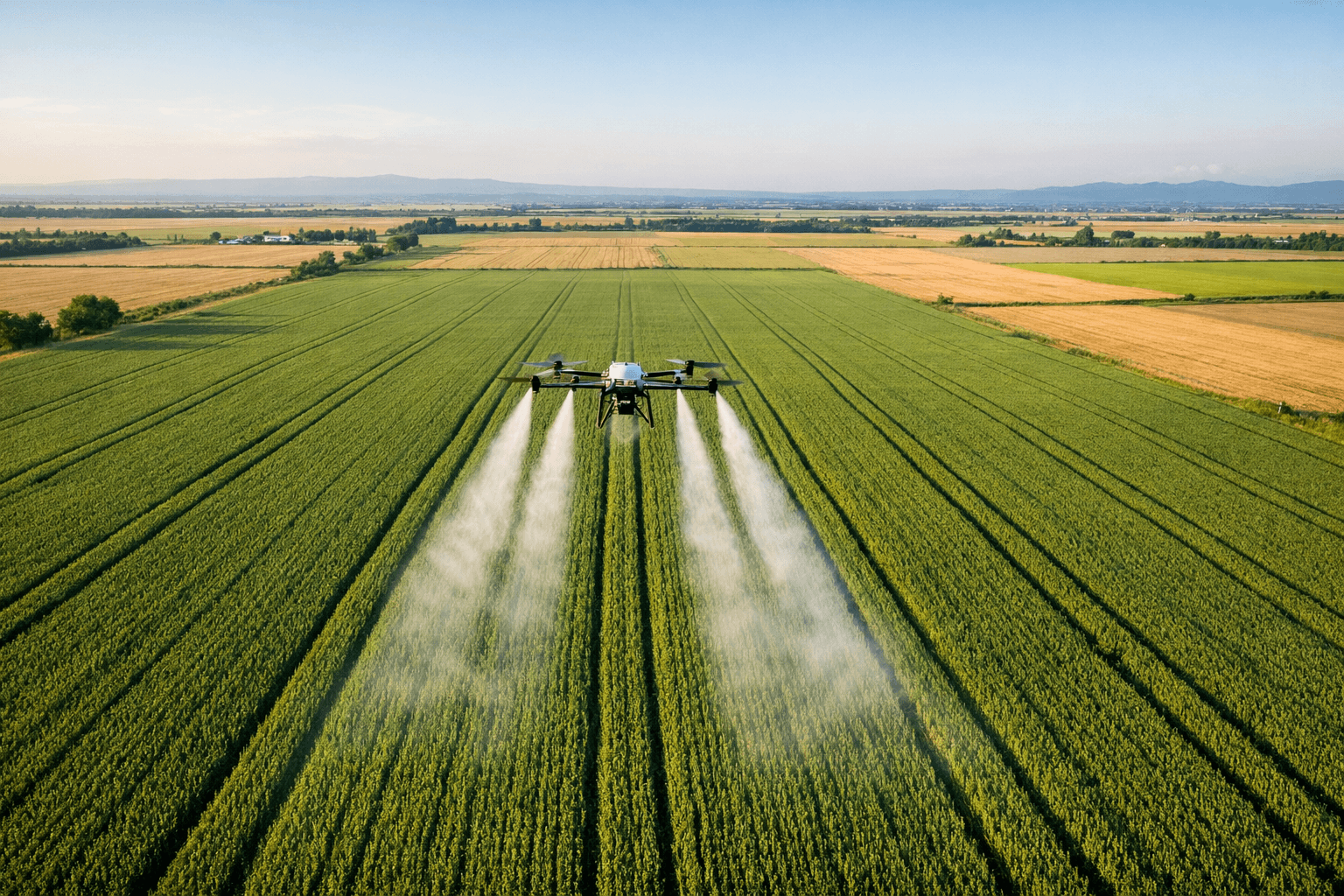
The software calculates the optimal route – the drone flies in parallel strips (like a tractor, but without the tracks), covering the entire area uniformly. The route is visualised on the tablet screen and the operator can adjust it if needed.
Interestingly, once created, the route can be saved and reused – for example during the next treatment of the same field.
Step 4: Loading with Preparation
While the route is being planned, the assistant prepares the working solution:
- Clean water is poured into cans
- The preparation is measured precisely with a dosing device
- The solution is mixed thoroughly
- The drone's tank (40 litres for the DJI Agras T50) is filled
The loading process takes 1–2 minutes. During work, refilling becomes routine – the assistant prepares the next batch while the drone is flying.
An important point: the drone uses concentrated solutions at 1–2 litres per decare, instead of 15–30 litres with a tractor. This means significantly less water and faster logistics. With a 40-litre tank and a rate of 1.5 L/dka, one fill covers approximately 27 decares.
Step 5: Autonomous Flight
Here is the exciting moment. The operator presses the start button and the drone takes off automatically. From this point it follows the pre-set route completely independently:
- Flies along straight strips at constant speed
- Turns precisely at the end of each strip
- Maintains exact height above the crop
- Regulates flow rate relative to its speed
The operator monitors the flight on the controller screen. He sees the drone's position in real time, the treated area, remaining solution and battery charge. If needed, he can stop the drone with a single button press or redirect it.
What does "autonomous" mean? The drone is not controlled with a joystick. It knows by itself where to fly, how fast, at what height and how much preparation to spray. The operator is there for monitoring and safety, not for "driving".
Step 6: Spraying with Precision Nozzles
While the drone is flying, the spraying system works continuously. Here is how it functions:
Centrifugal Nozzles
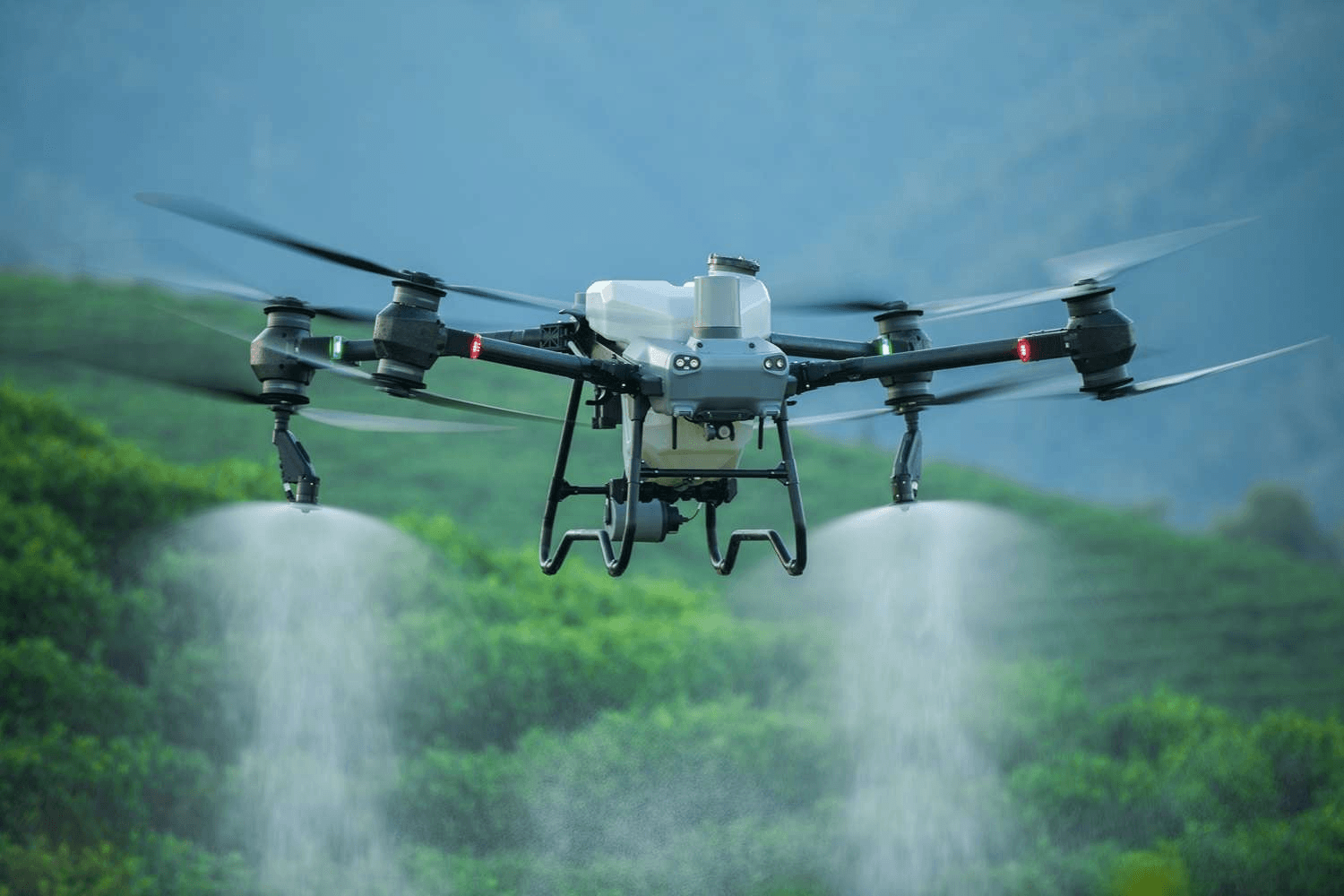
The DJI Agras T50 is equipped with centrifugal (rotary) nozzles – they do not simply release the liquid, but break it up into fine droplets of controlled size. Droplet size can be adjusted by the operator according to the type of preparation:
- Fine droplets (50–150 microns) – for fungicides and insecticides, better coverage
- Medium droplets (150–300 microns) – for most applications
- Coarse droplets (300–500 microns) – for herbicides, less drift
The Airflow Effect (Downwash)
The drone's rotors create a powerful downward-directed airflow. It does two things:
- Presses droplets towards the plants, instead of them being carried away by the wind
- Gently agitates the leaves, allowing the preparation to reach the underside – where pests often hide
This effect is unique to drones and cannot be achieved by a tractor sprayer or aircraft.
Intelligent Dosing
The spray flow control system regulates the spray rate in real time. If the drone slows down (due to wind or a turn), the flow rate automatically decreases so as not to overdose. If it speeds up – the flow rate increases. The result is absolutely uniform coverage across the entire area.
Step 7: Automatic Landing for Recharging
When the solution or battery runs out, the drone returns to the start point by itself and lands. An message appears on the operator's screen indicating what needs to be done – change the battery, top up the tank, or both.
The procedure is fast:
- Battery swap: 2–3 minutes (plug-and-play system)
- Tank refill: 1–2 minutes
- Both: 3–4 minutes
After recharging, the drone continues exactly where it stopped. The system remembers the last treated point and resumes the route automatically. No overlap and no gaps.
Additional Technologies: How the Drone Protects Itself from Errors
Obstacle Avoidance
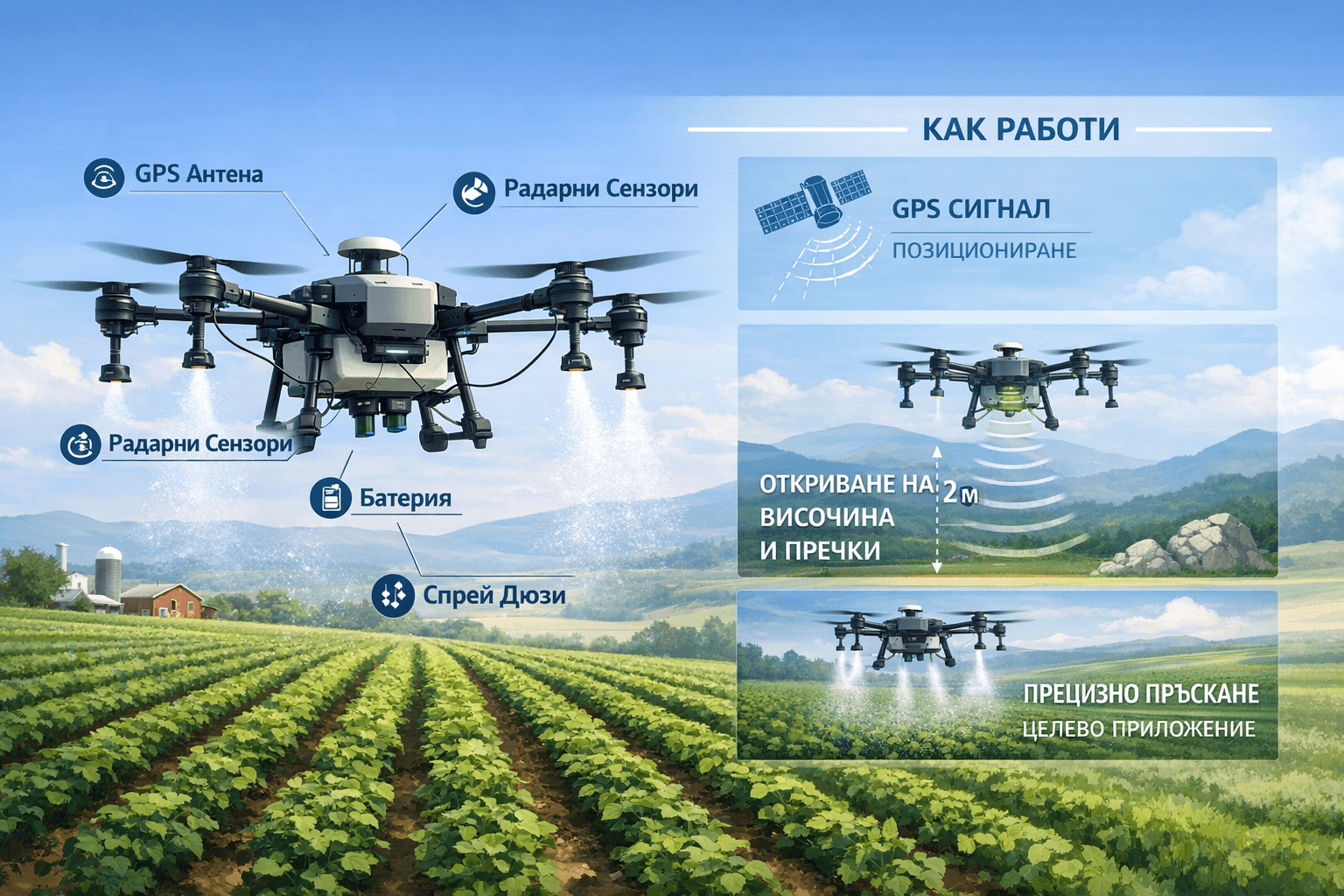
The DJI Agras T50 is equipped with dual radar (front and rear) and additional sensors that detect obstacles in real time. If the drone detects a tree, pole or wire:
- It first attempts to automatically navigate around it
- If it cannot – it stops and waits for instructions from the operator
This system also works at night, which is key for night treatments.
Terrain Following
Fields are not flat. The DJI Agras T50 uses a downward-facing radar that constantly measures the distance to the crop. If the terrain rises (a hill), the drone automatically rises. If it drops (a depression) – the drone descends.
Result: the drone always flies at the same height above the plants – regardless of terrain relief. This guarantees uniform spraying even on hilly plots.
RTK Precision
The RTK (Real-Time Kinematic) GPS system gives the drone accuracy of 1–2 centimetres. This means that spraying strips overlap with perfect precision – without duplication and without gaps. For detailed information on this technology, see the article on how agricultural drones work.
What the Farmer Sees: from Request to Result
Let us summarise the entire process from the farm owner's perspective:
- You call AirAgro or fill in the contact form
- We agree on the crop, area, preparation and date
- Our team arrives at the field on the agreed day
- Treatment begins – typically you see the drone for 2–3 hours for 500 dka
- You receive a report with treated area, preparation consumed and GPS map
It is that simple. You do not need to understand GPS, radar or nozzles. That is our job. Your job is to look after your farm – we take care of the crop protection, whether that is fungicide, herbicide or insecticide treatment.
We serve farms in the areas of Plovdiv, Stara Zagora, Pazardzhik, Haskovo, as well as in Dobrudzha and the entire Thracian Plain.
More about the complete process and what our drone spraying services include.
How Fast Is the Process in Reality
Actual productivity figures:
- 100–150 decares per hour under average conditions
- 1,500–2,000 decares per day under normal operation
- Up to 3,000 decares per day under optimal conditions
For detailed data, read our article on how many decares a drone sprays per day.
Safety and Regulations
Work with agricultural drone spraying is regulated by the General Directorate "Civil Aviation Administration" (GD CAA). AirAgro operators hold all necessary certificates and permits for working with agri drones. We strictly comply with:
- Regulations on flight height
- Requirements for distance from populated areas
- Rules for working with plant protection preparations
- Activity insurance
Required Certificates and Licences for Drone Spraying
For legal performance of crop protection activities with a drone in Bulgaria, the following are required:
- BFSA licence (Bulgarian Food Safety Agency) – for performing crop protection activities
- RHI permit – for working with plant protection products
- DJI Academy certificate – for professional and safe operation of agri drones
- Status of Professional User of PPP (Plant Protection Products) – mandatory for applying preparations
- Certificate from GD CAA – for operating unmanned aerial systems
AirAgro operators hold all the above licences and certificates. When you hire our drone spraying service, you do not need to worry about regulatory requirements – we cover everything.
Frequently Asked Questions
What are the main steps in spraying with an agricultural drone?
The process includes: team arrives with equipment, GPS mapping of the plot, route/dosage planning, loading with preparation and autonomous flight with precision spraying. The drone lands by itself for recharging and continues from where it stopped. The entire process is the foundation of precision agriculture.
How accurate is the GPS on agricultural drones?
The DJI Agras T50 uses RTK navigation with GNSS corrections, providing accuracy of 1–2 centimetres. This guarantees perfect strip overlap, without gaps and without duplication, whether you are spraying in the plains of Dobrudzha or the hilly terrain around Pazardzhik.
How long does the agricultural drone battery last?
One DJI Agras T50 battery provides 8–12 minutes of flight depending on load. A battery swap takes only 2–3 minutes. Our team carries a minimum of 6–8 batteries, so work is not interrupted. Read more about how many decares a drone sprays per day.
In what meteorological conditions can the drone work?
The DJI Agras T50 works in winds up to 6 m/s. In stronger wind spraying is stopped. Rain is a contraindication – not because of the drone, but because the preparation is washed off wet leaves. The drone can work at night – when wind is at its weakest and humidity higher, which improves crop protection effectiveness.
What qualifications must the agricultural drone pilot have?
AirAgro operators hold all necessary certificates from GD "Civil Aviation Administration", training for work with plant protection preparations and activity insurance. When you hire our service, this is not your concern – we provide everything necessary.
Conclusion
How does an agricultural drone work? In brief: the operator arrives, maps the field with GPS, plans the route in software, loads the preparation and launches the drone. From that point the machine flies automatically, sprays precisely and lands by itself for recharging. The process is fast, effective and safe.
Modern agricultural drones like the DJI Agras T50 are engineering marvels – but for the farmer they are simply a tool that gets the job done faster, more precisely and without trampling. You don't need to understand the technology – you just need to trust the right team.
Request a Free Consultation from AirAgro
Curious how the drone will perform on your field? AirAgro offers a free consultation and farm inspection for farms in the areas of Plovdiv, Stara Zagora, Pazardzhik, Haskovo, Dobrudzha and the Thracian Plain.
What we offer:
- 🌾 Free consultation – we explain exactly what we will do and how much it will cost
- 🚁 Drone demonstration – see the DJI Agras T50 in action on your field
- 📋 Individual treatment plan – crop protection programme for the entire season
- 📉 Farm inspection – terrain assessment and personal quote
📞 Call us for a free consultation – no hidden conditions. See our drone spraying services and current prices.