What Is Precision Agriculture – Technologies and Benefits for Farmers
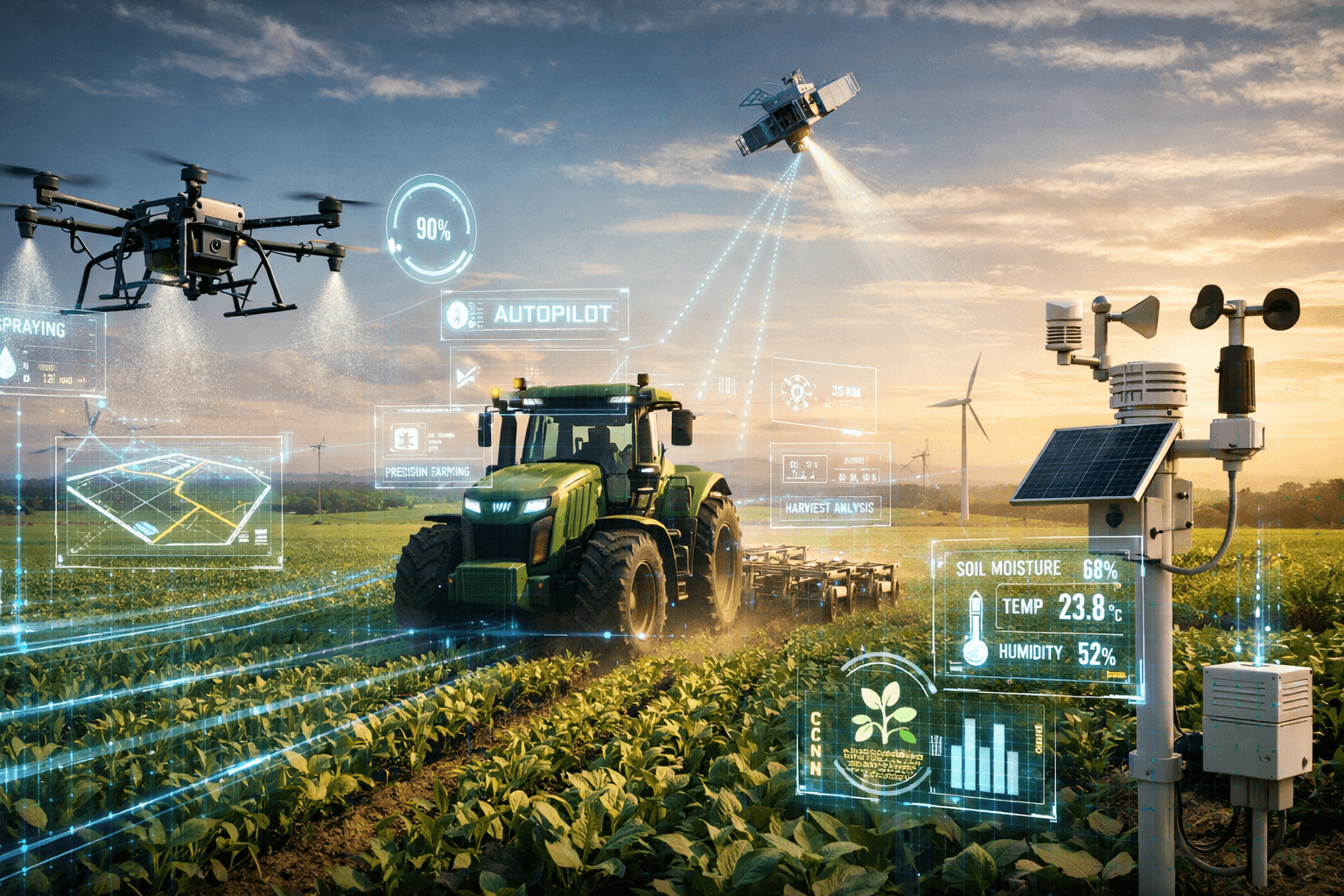
What is precision agriculture? In brief – it is an approach in farming in which every operation is performed with maximum accuracy, in the right place and at the right time. Instead of treating the entire field uniformly, precision agriculture analyses differences in soil, growth and problems zone by zone and applies an individual approach.
In this article we will look at the key technologies behind precision agriculture, how drones fit into this concept and what the real benefits are for Bulgarian farmers.
The Basic Principle: the Right Amount, in the Right Place, at the Right Time
Traditional agriculture works on the principle of "the average value" – the entire field block receives an equal dose of fertiliser, an equal amount of preparation and an equal seeding rate. The problem is that fields are not homogeneous.
A field of 1,000 decares may have:
- Areas with different soil acidity
- Zones with higher or lower moisture
- Areas with different nutrient content
- Places with stronger weed infestation or pest attack
Precision agriculture solves this problem by treating each zone according to its specific needs. The result: less waste of resources and higher yields.
Key Technologies in Precision Agriculture
1. GPS Navigation and Auto-Steer
GPS technology is the foundation of precision agriculture. Modern tractors and agricultural drones use GPS with RTK correction for centimetre accuracy. This allows:
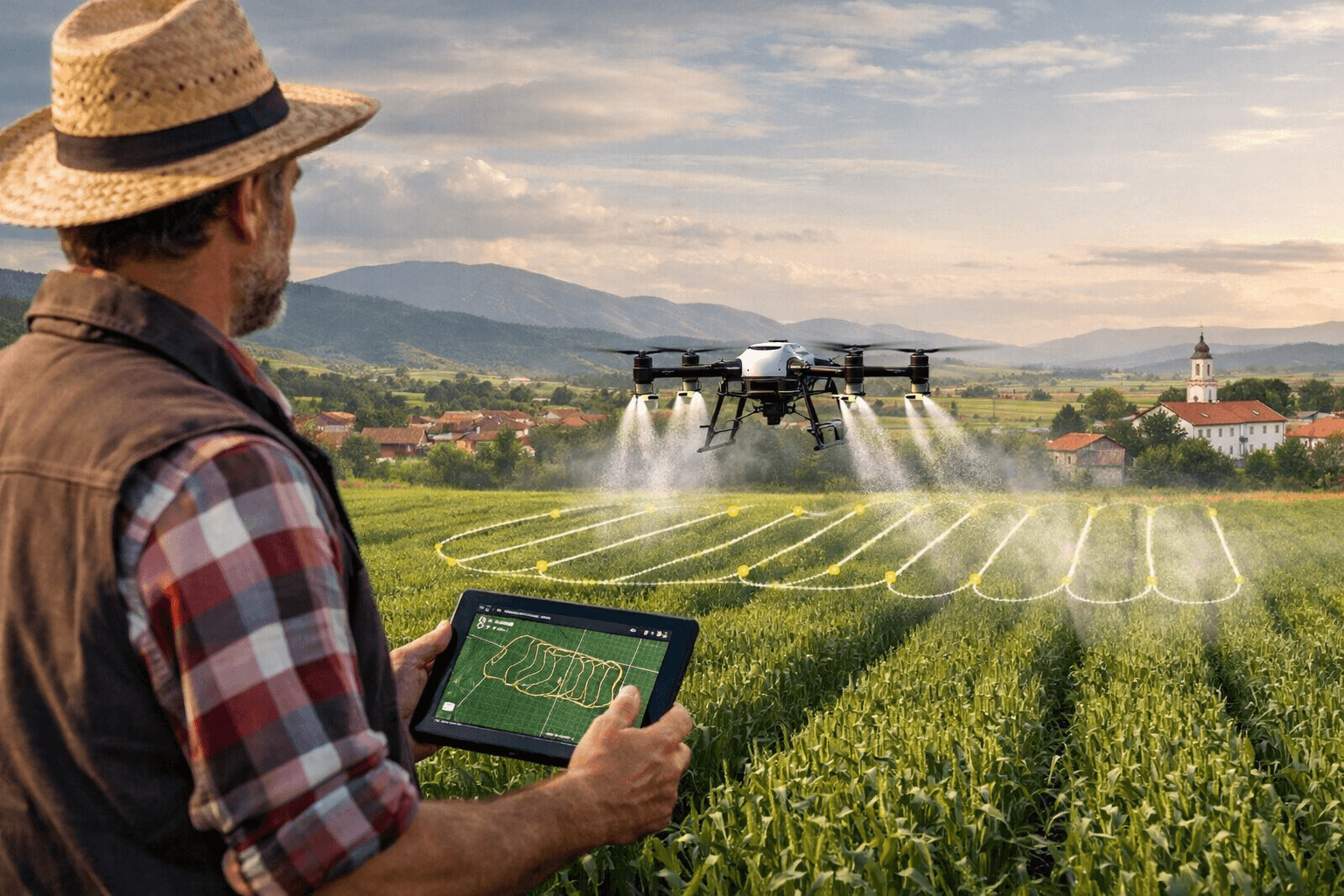
- Parallel guidance – the tractor or drone moves along perfectly parallel lines, without gaps and overlaps
- Section control – automatic switching of individual sprayer sections on and off in previously treated zones
- Repeatability – the machine follows an identical route on every pass, season after season
For drones like the DJI Agras T50, RTK navigation provides accuracy of 1–2 centimetres, which is unachievable by traditional methods.
2. VRA – Variable Rate Application
VRA is one of the most powerful technologies in precision agriculture. Instead of applying the same dose of fertiliser or preparation everywhere, the system automatically changes the dose in different zones of the field.
How it works:
- A prescription map is created – a visual map showing what dose is needed in each zone
- The map is loaded into the controller of the tractor or drone
- During operation, the machine automatically regulates the flow
For example, if soil analyses show that the southern part of the field has a nitrogen deficit, the system will increase the fertiliser dose only in that zone, while applying the standard rate in the rest. The result: 10–20% saving on fertilisers at the same or higher yield.
3. Soil Sensors and Analyses
Precision agriculture relies on soil data. Modern technologies include:
- Soil mapping – scanning electrical conductivity of soil to determine texture (clay, sand, humus)
- Moisture sensors – mounted in the field, transmitting real-time data
- pH mapping – determining acidity zone by zone
- Nutrient analysis – nitrogen, phosphorus, potassium and microelements
These data are converted into maps used for VRA applications.
4. Satellite Imagery and NDVI Indices
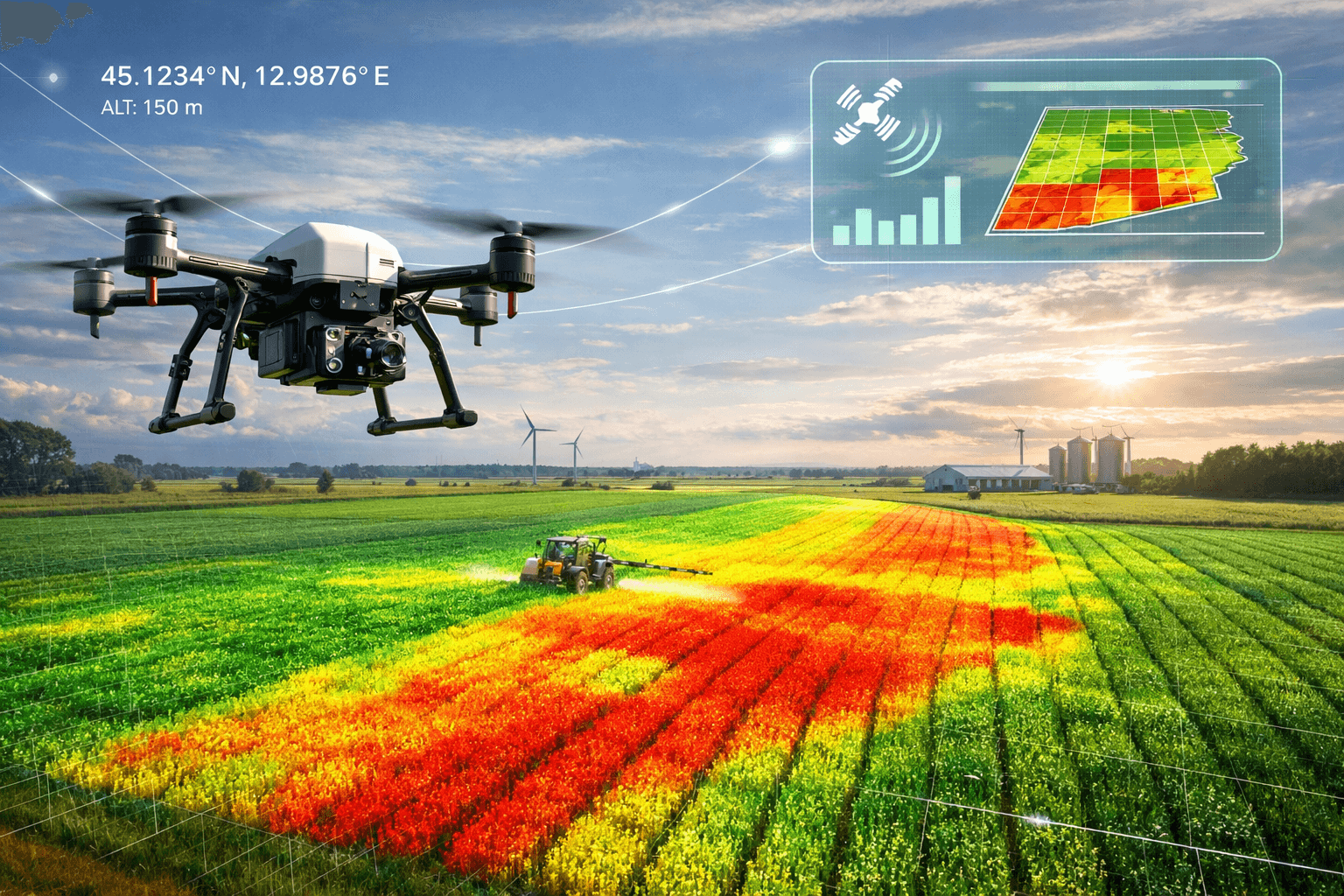
Earth observation satellites (such as the European Sentinel programme) provide free multispectral images of every field. The most commonly used index is NDVI (Normalized Difference Vegetation Index) – a numerical value showing plant health.
- High NDVI (0.6–0.9) – healthy, actively growing crop
- Low NDVI (0.2–0.4) – stressed plant, problem zone
Farmers can use NDVI maps to identify problem zones before they become visible to the naked eye. This enables early intervention – targeted treatment instead of full-field spraying.
5. Drones in Precision Agriculture
Drones fulfil two key roles in precision agriculture:
Monitoring and Mapping
Drones with multispectral cameras photograph fields and create detailed vegetation maps. Unlike satellite images, drones offer:
- Higher resolution – up to 1 cm/pixel
- On-demand photography – without waiting for a satellite pass
- Operation in cloudy weather – when satellites cannot "see" the field
Precision Spraying and Fertilisation
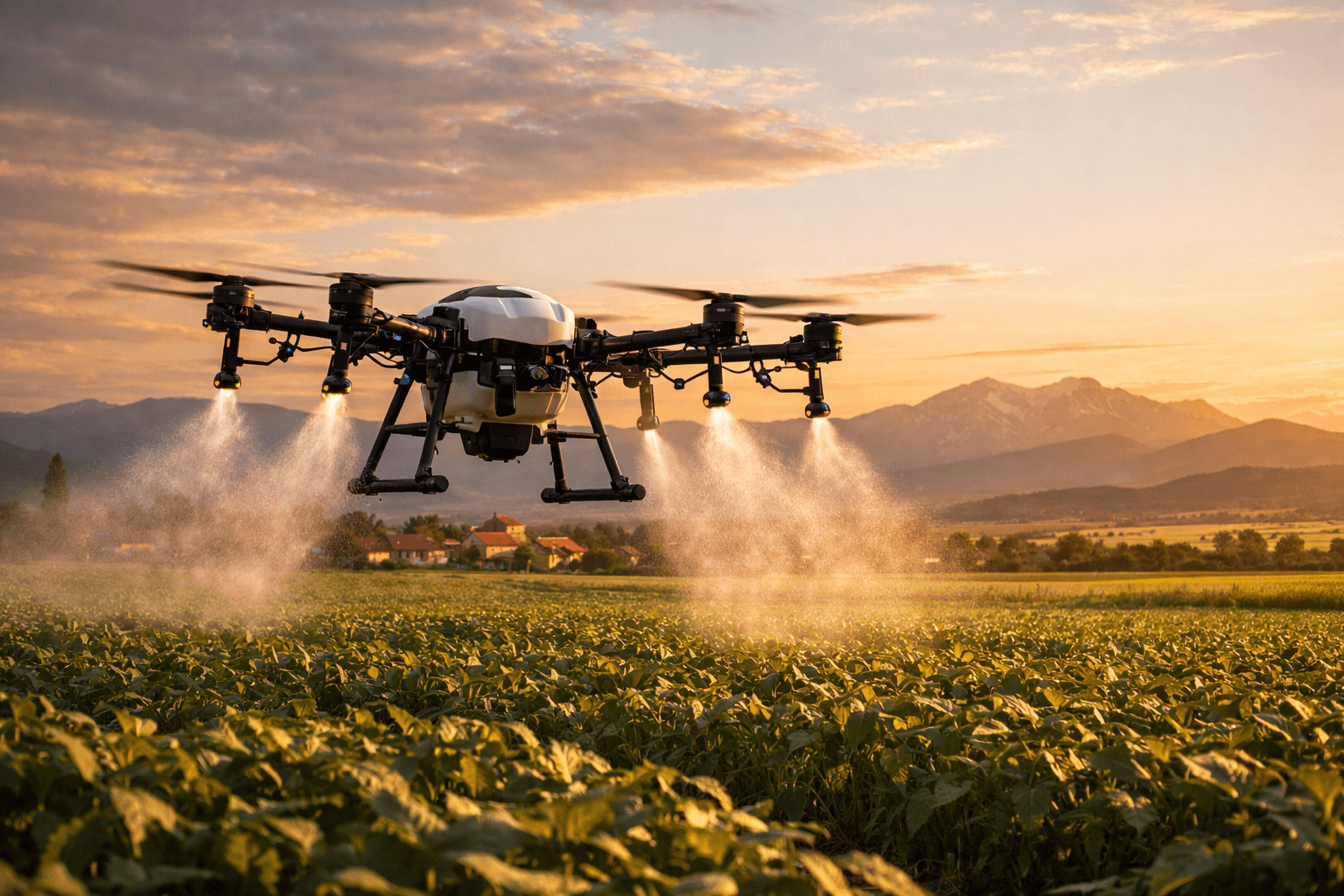
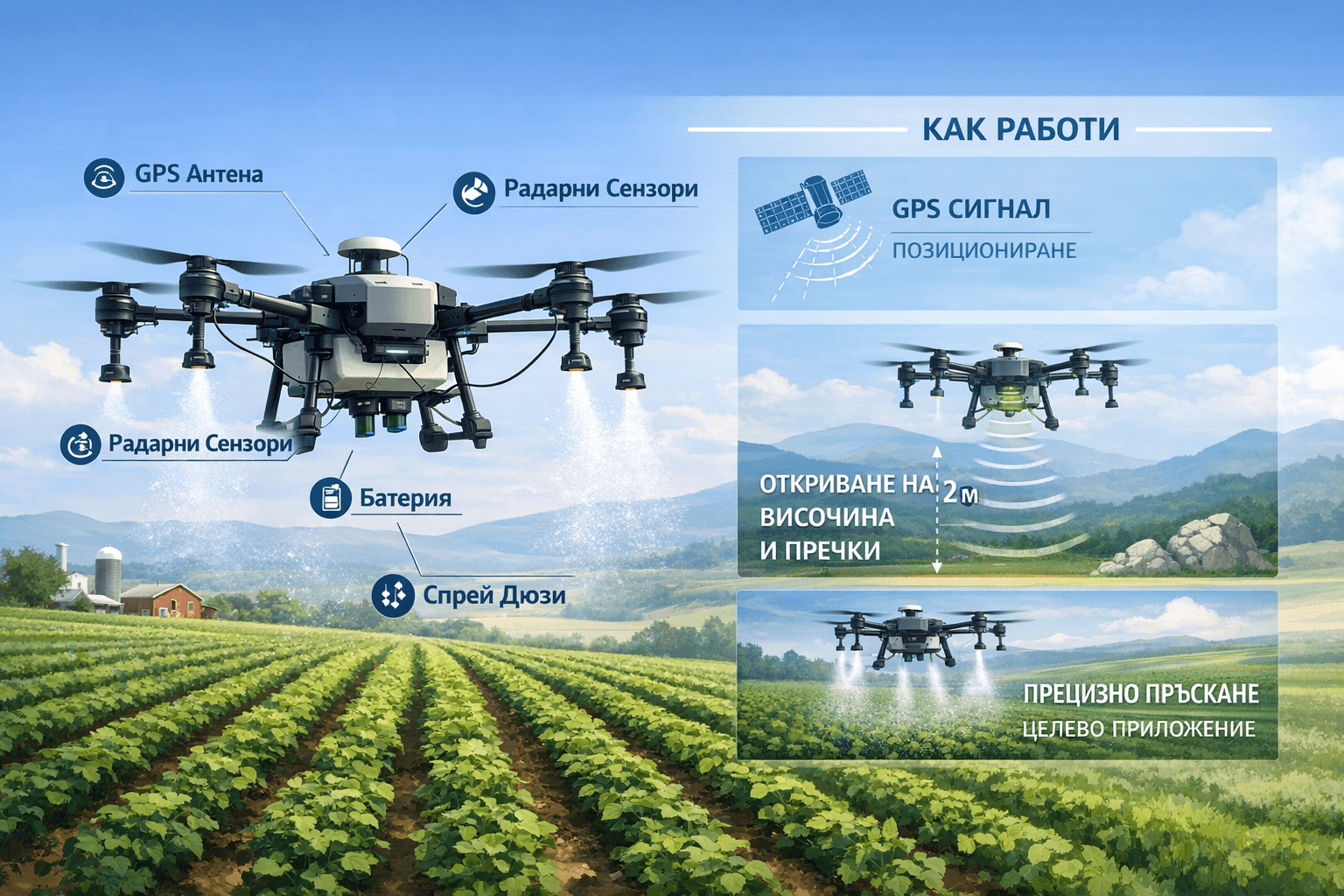
Agricultural drones like the DJI Agras T50 are the ideal instrument for VRA spraying. They can:
- Fly only to the problem zone and treat locally
- Work according to prescription maps with automatic dose regulation
- Cover up to 530 dka per day with precision application
The combination of drone monitoring and subsequent precision treatment is one of the most effective applications of drones in crop protection.
6. Artificial Intelligence and Machine Learning
The latest technology in precision agriculture is artificial intelligence (AI). Machine learning algorithms analyse enormous arrays of data – satellite images, weather data, soil analyses, historical yields – and generate recommendations for action.
Examples of AI applications:
- Yield forecasting – with accuracy of 5–10%
- Early disease detection – from drone or satellite images
- Irrigation schedule optimisation – according to the forecast and soil moisture
- Automatic VRA map generation – without manual intervention
Benefits of Precision Agriculture for Bulgarian Farmers
Resource Savings
Research shows that precision agriculture provides:
- 10–30% saving on fertilisers through VRA
- 15–25% saving on preparations through targeted treatment
- 5–15% saving on seeds through optimised seeding
- 10–20% reduction in fuel costs through optimal routes
For a farm of 2,000 dka of wheat, these savings can reach 15,000–30,000 BGN per year.
Higher Yields
When every plant receives exactly what it needs, yields naturally rise. European research shows a yield increase of 5–15% with precision agriculture application.
Environmental Benefits
Less waste of chemicals means:
- Less contamination of groundwater
- Preservation of beneficial insects
- Reduced carbon footprint
- Compliance with European sustainability requirements
Documentation and Accountability
Precision technologies automatically record every operation – GPS coordinates, date, dose, operator. This documentation is:
- Useful during BFSA inspection
- Required for certifications (GlobalGAP, etc.)
- Required when applying for European subsidies
European Subsidies for Precision Agriculture
The European Union actively supports the implementation of precision agriculture through the Common Agricultural Policy (CAP) and the Green Deal. For Bulgarian farmers the following are available:
Sub-measure 4.1 – Investments in Agricultural Holdings
Finances the purchase of:
- GPS systems for tractors
- Drones for monitoring and spraying
- Soil sensors and stations
- Farm management software
The subsidy covers up to 50–70% of the investment (depending on criteria).
Eco-Schemes under CAP 2023–2027
Farmers applying precision agriculture receive additional payments per decare for:
- Reduced pesticide use
- Precision VRA fertilisation
- Crop monitoring with drones or satellites
These incentives make investment in precision agriculture even more attractive.
How to Start with Precision Agriculture
There is no need to invest immediately in expensive equipment. Here are steps for gradual implementation:
Step 1: Basic Mapping
Start with soil analyses and NDVI maps from free satellite platforms. Many online services offer free access to Sentinel data.
Step 2: GPS Navigation
If your tractor doesn't have GPS, investment in an aftermarket GPS system is one of the fastest-returning investments.
Step 3: Precision Drone Spraying
Hire a professional drone spraying service – without initial investment you gain access to precision technology. The DJI Agras T50 applies VRA according to set maps with RTK accuracy.
Step 4: VRA Fertilisation
With accumulated data from previous seasons, start applying variable rate fertilisation.
Step 5: Full Integration
Combine all technologies in modern agriculture into a unified farm management system.
The Future of Precision Agriculture in Bulgaria
Bulgaria has enormous potential for precision agriculture. The Thracian Plain – including the areas around Plovdiv, Stara Zagora and Pazardzhik – is ideal for applying GPS-based technologies in vineyards, orchards and vegetables. In the Haskovo area precision fertilisation and spraying improves yields with cotton and tobacco. Dobrudzha with its vast grain areas is perfect for VRA and autonomous drone operations on large areas.
With the support of EU subsidies and falling technology prices, precision agriculture will become standard, not the exception, in the next 5–10 years. The growing number of young farmers with technical literacy in these regions further accelerates innovation adoption.
Frequently Asked Questions
What is precision agriculture in simple terms?
Precision agriculture is an approach where each zone of the field is treated individually – with the exact dose of fertiliser, preparation or water it needs. Instead of uniform treatment of the entire field, technologies such as GPS, drones and sensors analyse differences and apply optimal solutions zone by zone.
How does precision agriculture reduce costs?
Through VRA (variable rate application) and targeted treatment, precision agriculture provides 10–30% savings on fertilisers and 15–25% savings on preparations. Drones additionally reduce water consumption and eliminate trampling losses (3–5% of the harvest). For a farm of 2,000 dka, savings reach up to 30,000 BGN per year.
What is the role of drones in precision agriculture?
Drones fulfil a dual role: monitoring (photography with multispectral cameras for NDVI analysis) and precision treatment (spraying and fertilisation according to VRA maps with RTK accuracy ±10 cm). The DJI Agras T50 is ideal for precision spraying of fields in the Thracian Plain and Dobrudzha.
Is precision agriculture suitable for small farms?
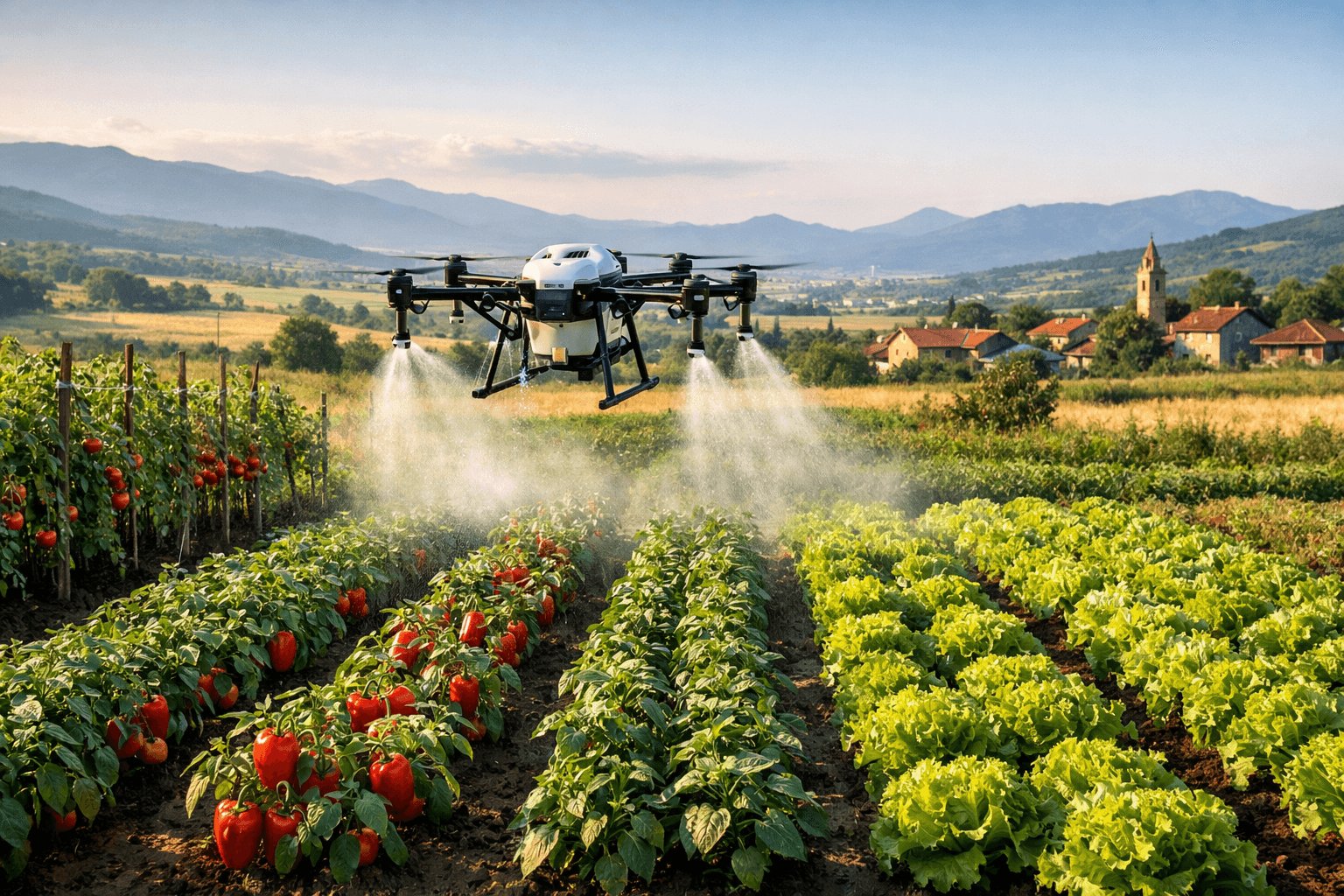
Yes. Small farms (200–500 dka) can benefit from precision agriculture without initial investment – by hiring a drone service. Drones treat problem zones in a targeted manner, which is especially advantageous for vineyards, orchards and vegetables around Plovdiv, Pazardzhik and Haskovo.
How can I start with precision agriculture?
The easiest way is to request a free consultation with AirAgro. Our team will carry out a farm inspection, analyse crop needs and propose a precision drone treatment plan. No own equipment needed – we provide everything.
Conclusion
What is precision agriculture? It is the future of farming – and it is already here. With GPS navigation, drones, sensors and artificial intelligence, farmers can manage their farms more efficiently, reduce costs and increase yields.
Drones, and specifically the DJI Agras T50, are one of the most accessible entry points to precision agriculture – especially when hired as a service.
Want to apply precision agriculture on your farm? AirAgro offers professional drone spraying with the DJI Agras T50, including VRA map-based work for farms in Plovdiv, Stara Zagora, Pazardzhik, Haskovo and the entire Thracian Plain.
🚁 Request a free consultation and farm inspection – our team will prepare an individual treatment plan and arrange a drone demonstration directly on your field.
📞 Call today or write to airagro.bg – start with precision agriculture now!