What Is Greenhouse Shading and Why Is It So Important?
During the summer months, peak temperatures inside greenhouses can exceed 50 °C, leading to leaf burn, cessation of pollination and significant harvest losses. Greenhouse shading entails applying a special shading paint (also known as "shading compound") to the glass, polycarbonate or polyethylene of the structure, which reflects part of the solar radiation and protects the crop from burning and heat stress.
At AirAgro we apply COVER X2 – a temporary shading paint that gradually washes off on its own over 3–4 months and is suitable for glass, polycarbonate and polyethylene greenhouses.
This is an established practice in Western Europe, Turkey and Israel, and in recent years it has been increasingly adopted in Bulgaria too – especially in the regions of Plovdiv, Pazardzhik, Haskovo and Stara Zagora, where greenhouse production is concentrated.
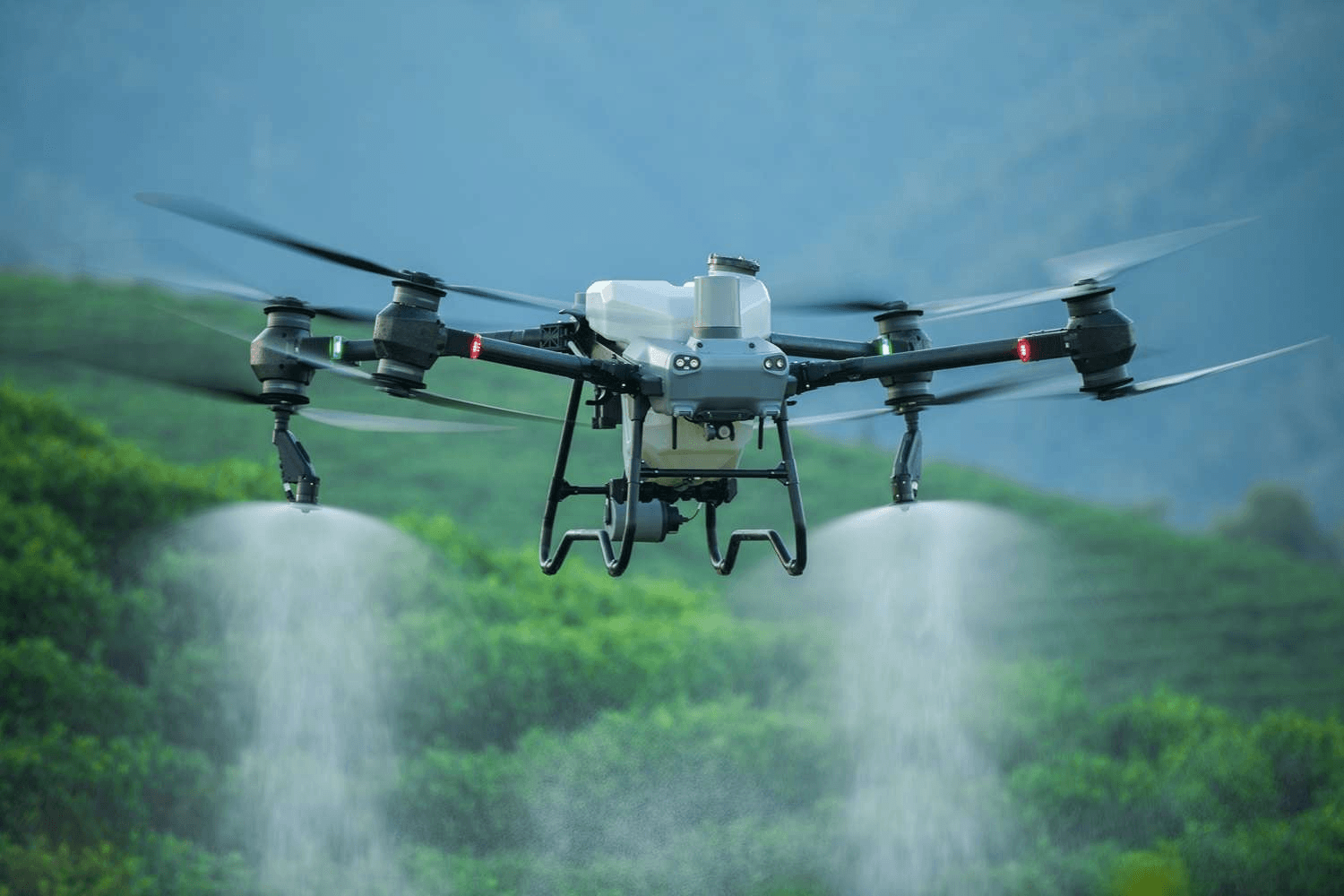
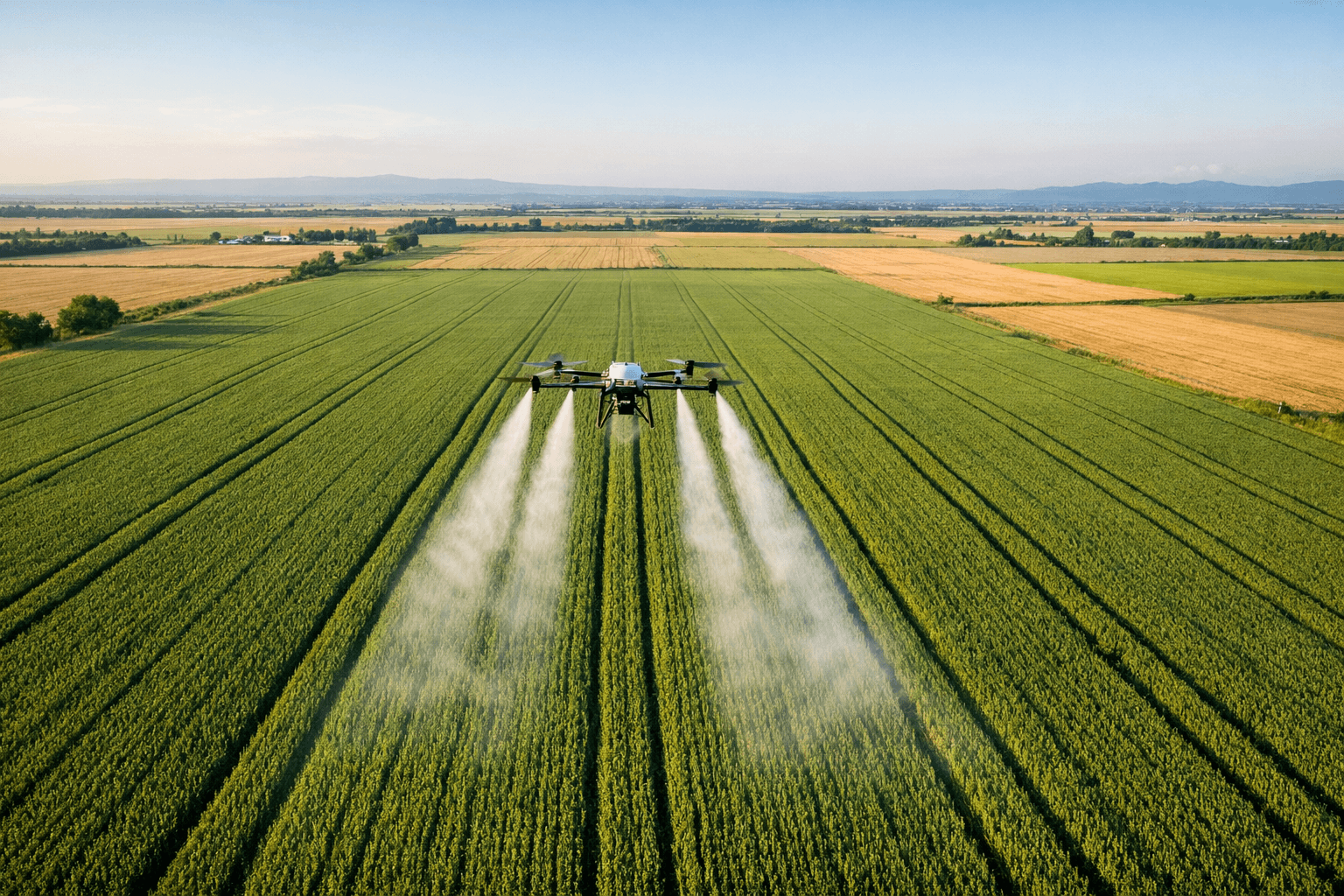
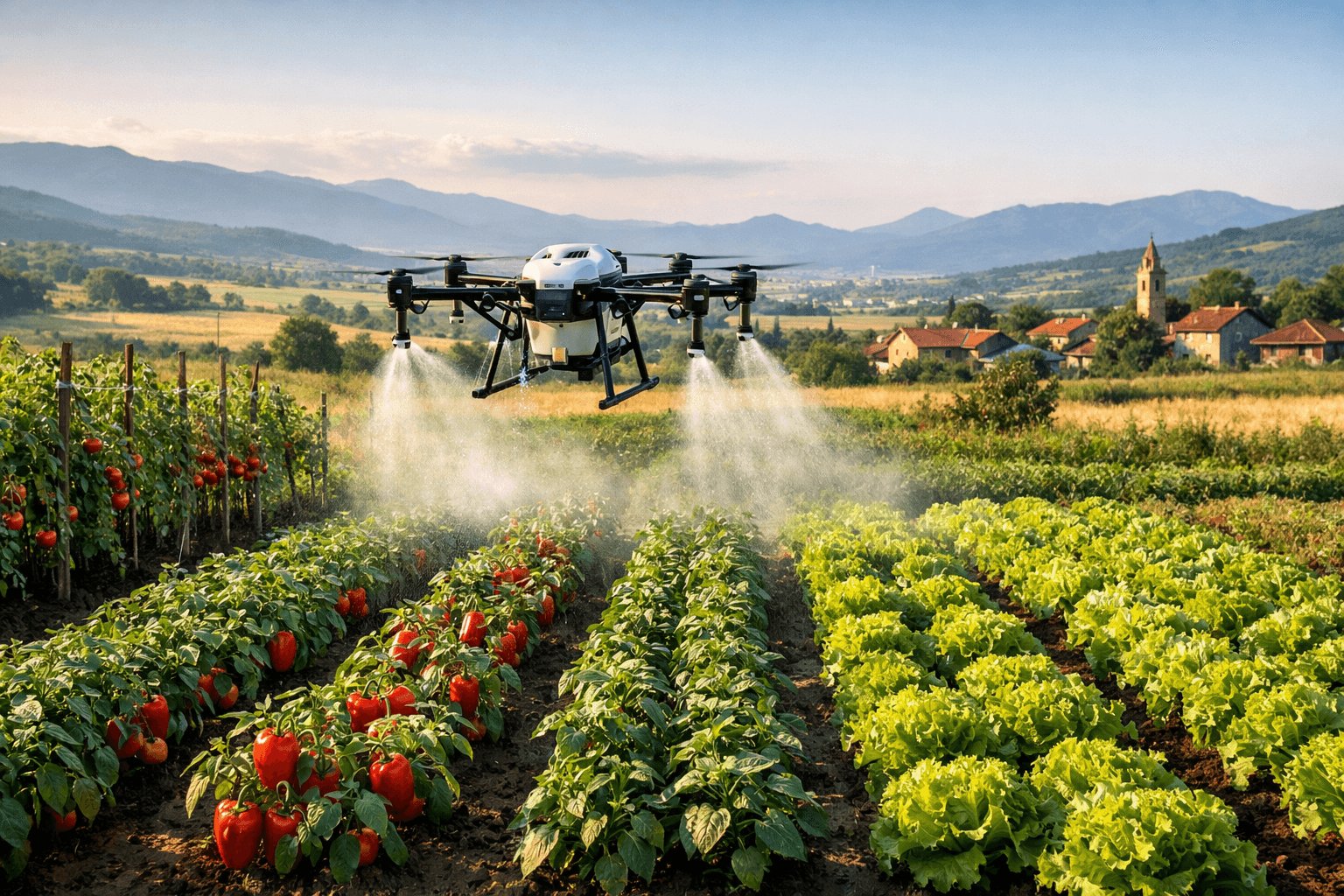
Traditionally, shading paint is applied manually or with ground sprayers, but today greenhouse shading with a drone offers a dramatically faster, safer and more uniform approach. At AirAgro we use the DJI Agras T50 – the most advanced agri-drone on the market – to provide this service to greenhouse farmers throughout Southern Bulgaria.
Traditional Methods vs. Drone Shading
Manual Application
With the classic approach, workers climb onto the greenhouse roof with brushes or rollers and apply the paint by hand. This is:
- Slow – a team of 4–5 people covers only 1,000–2,000 m² per day
- Dangerous – working at height without proper safety equipment
- Uneven – different layer thicknesses lead to "hot spots"
- Expensive – high labour and scaffolding costs
Ground Sprayers
Faster than manual application, but with limitations for tall greenhouses, complex roof shapes and difficult-to-access sections. Spraying upwards from below leads to material loss and uneven coverage.
Drone for Shading – the New Standard
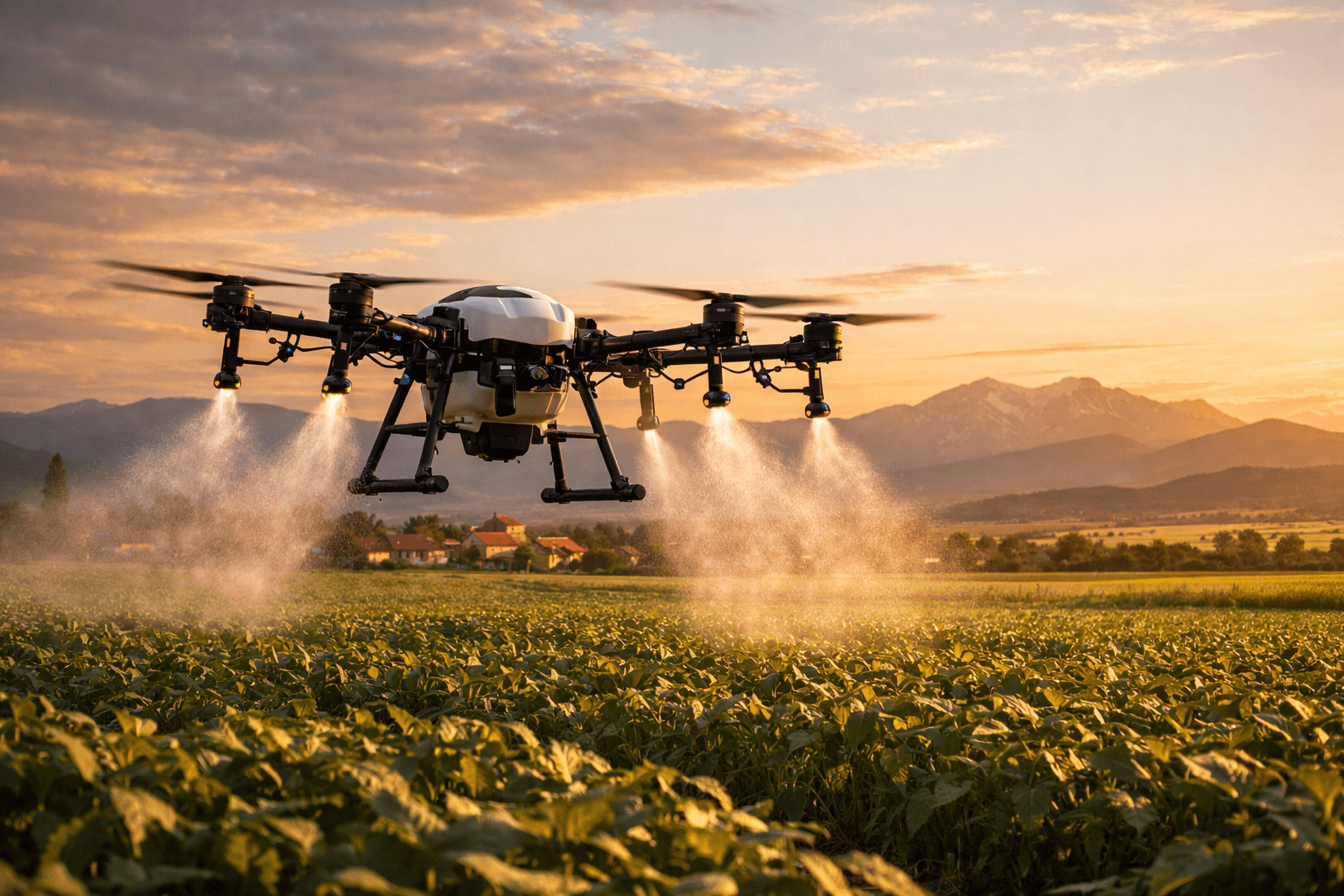
With a drone like the DJI Agras T50, shading paint is applied from top to bottom – exactly the way sunlight falls. The result is:
- A perfectly uniform layer across the entire surface
- Coverage of up to 10,000 m² per hour (10 decares)
- Zero risk for workers – no scaffolding and no climbing onto roofs
- Minimal material consumption thanks to precision nozzles
How the DJI Agras T50 Applies Shading Paint
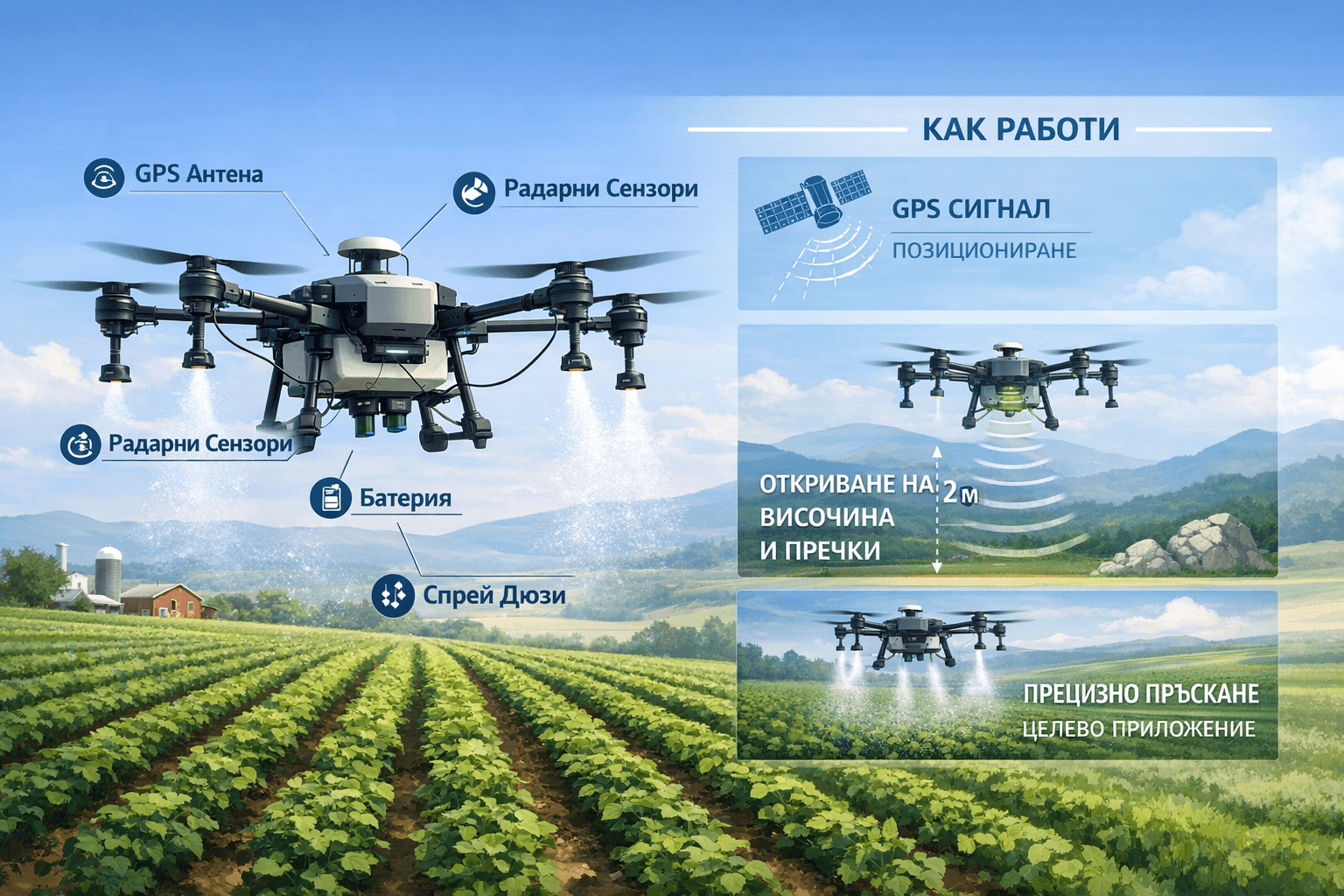
The DJI Agras T50 is DJI's flagship in the agri-drone segment and is ideal for painting greenhouses with a drone. Here are its main features that make the service possible:
| Parameter | Value | | --------------- | ------------------------ | | Tank | 40 litres | | Working width | up to 11 metres | | Flow rate | 6–12 L/min (adjustable) | | Precision | RTK positioning (±10 cm) | | Autonomy | up to 20 min per flight | | Spraying system | Dual centrifugal nozzles |
Process Steps
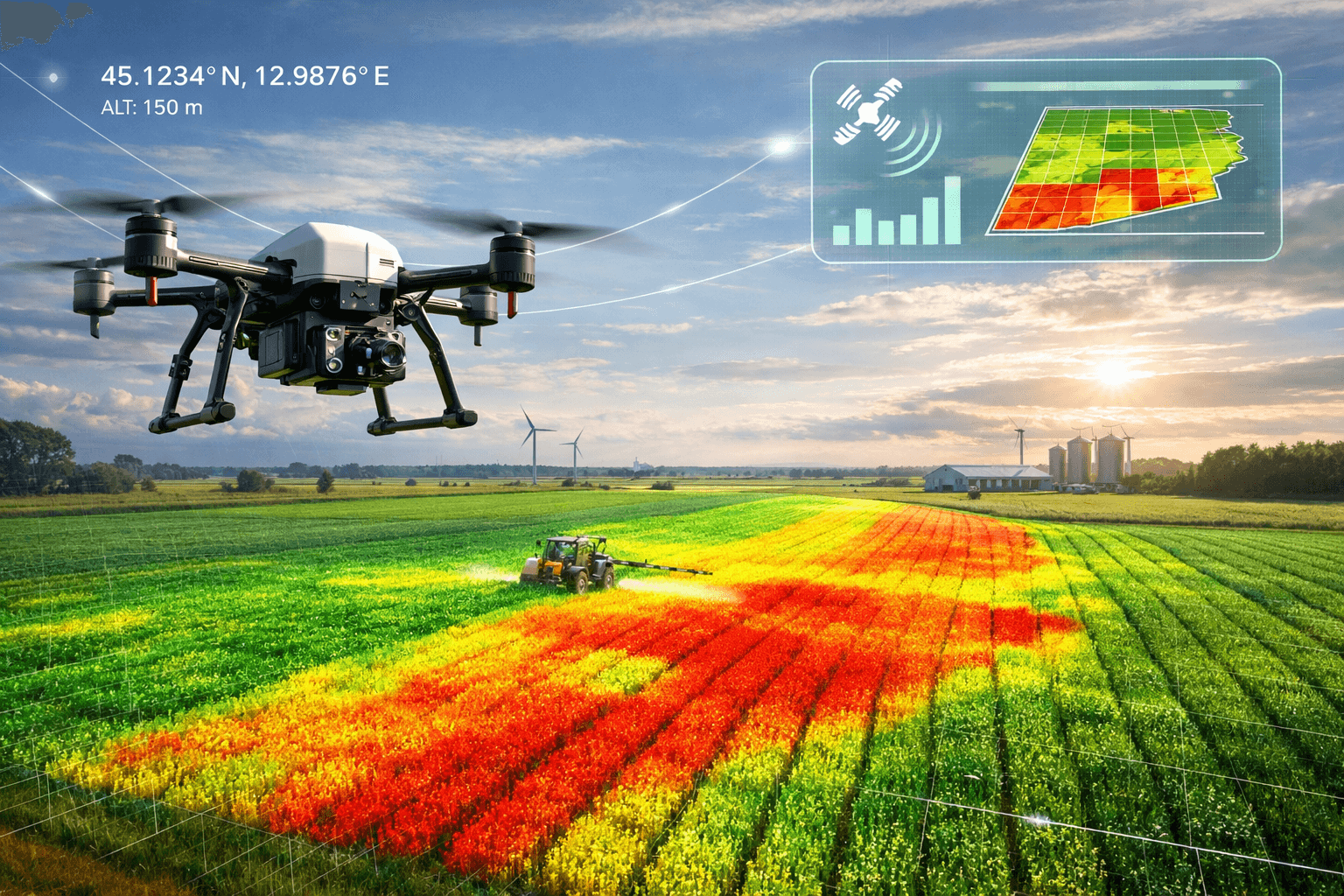
- Survey and planning – our pilot assesses the area, height and type of roof covering. A flight plan with precise GPS coordinates is prepared.
- Solution preparation – the COVER X2 paint is diluted according to the manufacturer's instructions and loaded into the drone's tank. One 22 kg pack of COVER X2 covers approximately 700–1,400 m², depending on the desired shading intensity.
- Automatic application – the drone follows the pre-set route with RTK precision. The DJI Agras T50's dual atomising system provides an adjustable droplet size from 50 to 500 µm across six levels, so the coating goes on evenly without clogging the nozzles.
- Quality control – after application we inspect the coverage and make an additional pass if needed.
The entire process for a greenhouse of 5,000 m² takes an average of 30–45 minutes – including preparation and loading. By comparison, the manual method requires 2–3 working days.
The Shading Paint We Use: COVER X2
For greenhouse shading we use COVER X2 – a temporary shading paint produced by Colorificio Valdecia (Italy). Its key properties:
- Temporary and self-removing – it gradually washes off on its own over 3–4 months, so there is no need for a separate removal agent or a second job to clean it off
- Universal – suitable for glass, polycarbonate and polyethylene greenhouses
- Economical – one 22 kg pack covers approximately 700–1,400 m², depending on the desired shading intensity
- Adjustable intensity – the shading level is controlled by the dilution and the number of passes, so we can tailor it to the crop and the season
- Sprayer-friendly – formulated to be applied with motorised and hand sprayers without clogging, which makes it ideal for drone application
Because the intensity can be regulated, we set the shading level according to the specific crop and the time of season during the on-site inspection.
Benefits of Greenhouse Shading with a Drone
1. Protection from Overheating
Correctly applied shading paint reflects part of the solar radiation and protects the crop from burning and heat stress during the hottest hours of the day. This helps keep the greenhouse climate closer to the comfort zone for most vegetable crops, with the most noticeable effect in directly heated zones at peak sun.
2. UV Protection for Crops
Excessive UV radiation causes:
- Burning of leaves and fruits
- Chlorophyll breakdown
- Reduced photosynthesis
Shading paint reflects part of the sunlight, reducing both light intensity and heat buildup while still letting through enough light for photosynthesis. By adjusting the dilution and the number of passes, we set how much light is held back to match the crop.
3. Better Humidity Control
Lower temperatures mean slower evaporation and more stable humidity (60–75%), which reduces:
- Plant stress
- Spread of fungal diseases
- The need for additional irrigation
4. Higher Yields
Shading helps keep the temperature below ~32 °C — the threshold above which tomatoes and peppers stop setting fruit. This extends the productive season by several weeks and reduces losses from sun scald. The yield benefits come from:
- A longer productive fruiting period
- Less flower abortion
- Less sun scald on the fruits
Important: excessive shading (above 50%) can harm growth. That is why we select the shading level according to the specific crop and season.
5. Speed and Efficiency
With the DJI Agras T50 we cover up to 10,000 m² per hour. This means that even a large greenhouse of 20–30 decares can be shaded in one working day – unthinkable with manual labour.
6. Safety
Zero need for scaffolding, ladders or roof climbing. Our pilots are certified by DJI Academy and work in strict compliance with all requirements of the General Directorate "Civil Aviation Administration".
7. Cost Effectiveness
Although the drone service appears more expensive at first glance, the total cost is lower because of:
- Less paint used (uniform application without waste)
- No scaffolding or labour hire costs
- Faster coverage = fewer labour hours
When Should You Shade Your Greenhouse?
Spring Application (April–May)
The optimal time for applying shading paint is late April to early May, when daytime temperatures begin to exceed 25 °C. In the Plovdiv and Pazardzhik area this is usually around 20–25 April, while in Haskovo and Stara Zagora – early May.
Natural Removal (Autumn)
COVER X2 is a temporary paint – it gradually washes off on its own over 3–4 months, so there is no separate removal step at the end of the season. By autumn the greenhouse cover is clear again, ready for the lower-light months.
Which Crops Benefit Most from Shading?
Tomatoes
Tomatoes are extremely sensitive to overheating. At temperatures above 35 °C, pollen loses viability and fruits do not set. Shading extends the active fruiting period by 3–4 weeks.
Peppers
Peppers react to excessive light with sunscald on the fruits. Greenhouse shading significantly reduces this problem.
Cucumbers
Cucumbers prefer diffused light rather than harsh direct sun. A shading coating softens the light and reduces heat stress on the canopy, which helps the plants stay productive through the hottest part of the season.
Flowers (roses, gerberas, chrysanthemums)
Floriculture greenhouses are among the most frequent clients for this service. Shading prevents colour fading and extends the vase life of cut flowers.
Nurseries
Young seedlings are particularly vulnerable to direct sunlight. Shading in nurseries is an obligatory practice for quality seedling production.
Greenhouse Shading with a Drone in Southern Bulgaria
AirAgro offers the greenhouse drone shading service throughout Southern Bulgaria, including:
- Plovdiv and Plovdiv Province – Sadovo, Parvomay, Asenovgrad, Rakovski
- Pazardzhik and Pazardzhik Province – Septemvri, Belovo, Velingrad
- Haskovo and Haskovo Province – Dimitrovgrad, Svilengrad, Harmanli
- Stara Zagora and Stara Zagora Province – Kazanlak, Chirpan, Radnevo
- The Thracian Plain – one of the largest greenhouse regions in the country
- Dobrudzha – we also serve northern regions upon request
Our pilots are certified by DJI Academy, and all preparations we use are approved by BFSA (Bulgarian Food Safety Agency) for use in agriculture.
How to Order the Service from AirAgro
The process is easy and fast:
- Contact us at tel. +359 884 242 406 or via the form at airagro.bg
- Free inspection – our specialist visits the greenhouse, measures the area and assesses the type of roof covering
- Individual shading plan – we recommend the appropriate paint type and application schedule
- Execution – the drone applies the paint in hours, not days
- Quality check and guarantee – we inspect coverage quality and guarantee uniformity
Learn more about our agri-drone services or see how we carry out vegetable spraying with a drone. For the full list of services visit our drone spraying page.
Frequently Asked Questions
How long does greenhouse shading with a drone take?
It depends on the area, but as a guideline: a greenhouse of 5,000 m² (5 decares) is shaded in 30–45 minutes. For greenhouses of 20–30 decares – within one working day. This is 5–10 times faster than the manual method.
Is the shading paint safe for plants and people?
Yes. All shading paints we use are certified for agricultural use and approved by BFSA. They are water-based, non-toxic and do not affect the quality of produce. Once they have served their purpose, the paints biodegrade naturally or are washed off with water.
Can the drone work in wind or rain?
The DJI Agras T50 has a protection class of IP67 and can operate in light winds (up to 6 m/s). We do not recommend application in strong wind or rain, as this affects the uniformity of coverage. Our pilots monitor meteorological conditions and schedule flights for optimal hours – usually early morning (6:00–10:00) or late afternoon (17:00–19:00).
How much does greenhouse drone shading cost?
The price depends on the greenhouse area, paint type and site accessibility. We provide a free consultation and inspection, after which we prepare an individual quote. Contact us at +359 884 242 406 for a specific price. Overall, the drone service is more cost-effective than the manual method for areas over 2,000 m².
How often should the greenhouse be shaded?
Once a year, at the beginning of the warm season (April–May). COVER X2 lasts 3–4 months and gradually washes off on its own, so a single application covers the hottest part of the growing season.
Conclusion – Invest in the Comfort of Your Crops
Greenhouse drone shading is a modern, fast and cost-effective solution that protects your crops from overheating, increases yields and reduces operating costs. With the DJI Agras T50 and the AirAgro team you get professional coverage in hours, not days.
Are you ready to protect your greenhouse?
- Request a free consultation and greenhouse inspection
- Ask for a demonstration of the technology on-site
- Receive an individual shading plan for your greenhouse
Call +359 884 242 406 or write to us at airagro.bg. We serve greenhouses in Plovdiv, Pazardzhik, Haskovo, Stara Zagora, Dobrudzha and the entire Thracian Plain.